


Zelenskyy, European leaders meet Trump in D.C.: Showmanship or real step towards peace?



On August 18 in Washington, Donald Trump met with the President of Ukraine and European leaders. The atmosphere was warmer than expected, but key issues — ending the war, security guarantees, and a potential meeting with Putin — remain unresolved. Still, the ice seems to have been broken, and all parties appear ready for a difficult conversation about Ukraine’s future
Contents
1. How the meeting went
2. Main results of the meeting
3. Assessments by international media and experts
The White House, a symbol of American power, became the stage for hours of intensive diplomatic talks. This time, Ukrainian President Volodymyr Zelenskyy did not come alone—he brought a strong delegation of European leaders. French President Emmanuel Macron, German Chancellor Friedrich Merz, British Prime Minister Keir Starmer, Italian Prime Minister Giorgia Meloni, Finnish President Alexander Stubb, European Commission President Ursula von der Leyen, and NATO Secretary General Mark Rutte attended to show unity and protect Europe’s interests.
According to CNBC, this was an “unprecedented effort” to achieve peace. Trump himself later noted that the White House has never hosted so many European leaders at once.
Espreso will provide a detailed look at how the negotiations have unfolded and what conclusions have been reached.
How the meeting went
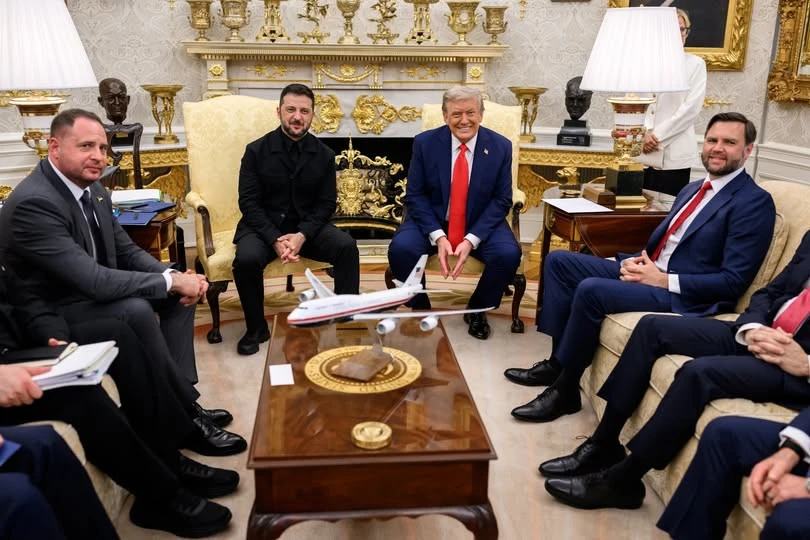
The meeting in Washington on August 18 between Trump and Zelenskyy,
photo: The White House
Many analysts said this was more than just a meeting — it was a critical moment in efforts to end the nearly four-year war in Ukraine. After Saturday’s summit in Alaska between Trump and Putin failed to produce a ceasefire, European leaders rushed to Washington to support Kyiv and prevent any deals being made behind Ukraine’s back.
Formally, the meeting, including European leaders, was prompted by a phone call between Zelenskyy and Trump. Its goal was straightforward but crucial: to coordinate positions after Trump’s summit with Putin, ensuring that Europe and the U.S. present a united front and shared understanding for ending the Russian-Ukrainian war.
According to The New York Times, the atmosphere of the Washington meeting was tense, but quite warm and constructive – in contrast to the stormy meeting in February, when Trump and Vance criticized Zelenskyy for “ingratitude”.
The meeting began at noon local time in the Oval Office with a one-on-one between Trump and Zelenskyy. For about 25 minutes, cameras were allowed as the two presidents spoke. Trump did most of the talking, often straying from the topic, mentioning “bad Biden” and saying he “loves all people: Ukrainians and Russians.” Zelenskyy was laconic but meaningful.
He thanked Trump repeatedly (11 times in just 4.5 minutes, according to the Washington Post). He also delivered a letter from Ukraine’s first lady, Olena Zelenska, to the U.S. first lady, thanking Melania Trump for her note to Putin regarding the return of Ukrainian children.
Zelenskyy even managed a joke: when a journalist who had asked about his suit in February mentioned it again, Zelenskyy quipped, “You are in the same suit. I changed, you did not,” prompting laughter from those present, including Trump.
Experts praised the Ukrainian president for this position; according to CNN, this time Zelenskyy "changed his tactics for Trump this time – and his outfit."
Afterward, the two presidents spent about half an hour alone, discussing near a map of Ukraine placed by the Americans opposite the Declaration of Independence. The map showed the front lines and the percentage of regions seized by Russian forces. Zelenskyy later said the map was helpful in showing Trump the real situation on the front.
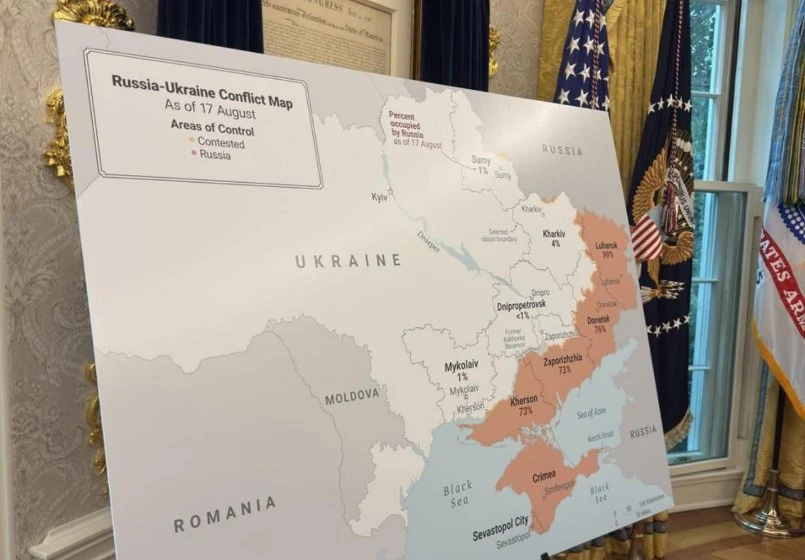
photo: social media
The leaders then posed for a joint “family photo,” as the White House described, in the Cross Hall with both presidents and European leaders.
Next, a multilateral meeting took place in the East Room with all the gathered politicians. Before the closed-door talks, each leader spoke on camera. Trump said a ceasefire was not strictly necessary for a peace agreement. According to Reuters, only Merz and Macron disagreed, insisting that a ceasefire must precede further negotiations with Russia. The other leaders mostly thanked Trump — Rutte, for example, praised him for the “breakthrough” on recognizing Ukraine’s security guarantees.
Finnish President Alexander Stubb explained his participation by noting that Finland has the second-largest land border with Russia and historical experience with wars and peace agreements, including the Winter War. Zelenskyy highlighted “strong signals” from the United States regarding the end of the war.
Behind closed doors, negotiations continued with interruptions and concluded in the Oval Office in a “leaders only” format. During this time, Trump called Putin to relay Europe’s position and “get feedback,” as Zelenskyy described.
Main results of the meeting
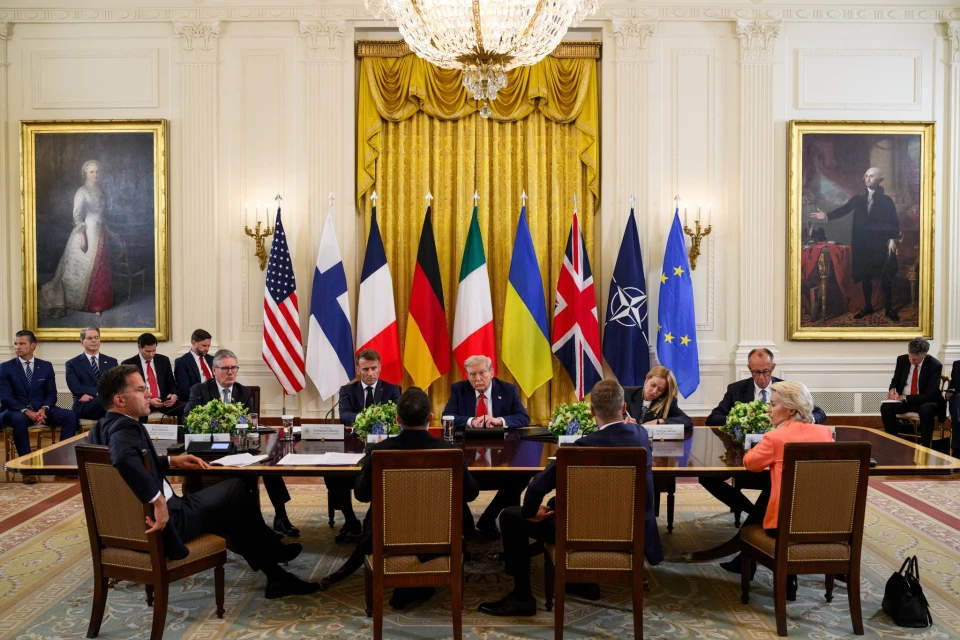
The meeting in Washington on August 18 between European leaders and Trump
photo: The White House
No specific agreements were signed, but that was not the main purpose of the Washington meeting. The key goal was to see whether the U.S. president had “given too much to Putin,” and so far, there is no evidence of that. At no point did anyone claim that Trump pressured Zelenskyy to accept any Kremlin ultimatums.
The first major outcome of the meeting is a political signal of unity. The U.S., the EU, and NATO publicly demonstrated joint efforts on security guarantees for Ukraine — an important step to prevent potential escalation if a peace agreement is reached.
“We discussed security guarantees. This is a key issue, as a start to the end of the war. We continue to work, coordinating steps among all allies seeking to end the war with dignity,” Zelenskyy said.
The specifics of the guarantees are still being developed. Zelenskyy noted that Ukraine plans to formalize them on paper within the next 7–10 days. NATO leaders added that European countries have been working on these guarantees for over three months.
As expected, Trump confirmed that Ukraine would not join NATO, but Ukrainians would receive “strong guarantees” after the war, involving U.S. support and weapons. Earlier, the Trump administration said these guarantees would resemble NATO’s Article 5, under which an attack on one member is considered an attack on all. While Trump did not explicitly mention this in Washington, Italian Prime Minister Giorgia Meloni proposed a series of guarantees from Western countries modeled on Article 5.
According to the WSJ, U.S. Secretary of State Marco Rubio will lead a working group of national security advisers and NATO representatives to draft security guarantees for Ukraine. Sources say the guarantees will include four components: a military contingent, air defense, armaments, and monitoring of the cessation of hostilities.
“Some will likely handle presence, some intelligence, some naval security, some airspace security. Others, who cannot constitutionally act, can finance military production in Ukraine,” Zelenskyy said.
The Financial Times reports that Ukraine has offered the U.S. a $100 billion arms deal to secure these guarantees, with Europe covering the costs.
Another key outcome of the meeting was the agreement that territorial issues can only be discussed at the level of the Ukrainian and Russian presidents. Zelenskyy confirmed at a briefing that a meeting with Putin is possible. During the Trump-Putin conversation, Putin agreed to a bilateral meeting with Zelenskyy, followed by a trilateral one that would also include Trump.
According to the German Chancellor, such a meeting could take place within the next two weeks.
"We don’t know whether the Russian president will have the courage to attend such a summit. Therefore, persuasion is needed," Merz said.
So neither the exact place nor the exact time is yet known. In addition to Rome and Geneva, which are considered the main cities for a potential meeting, Istanbul and Budapest are also being discussed.
Assessments by international media and experts
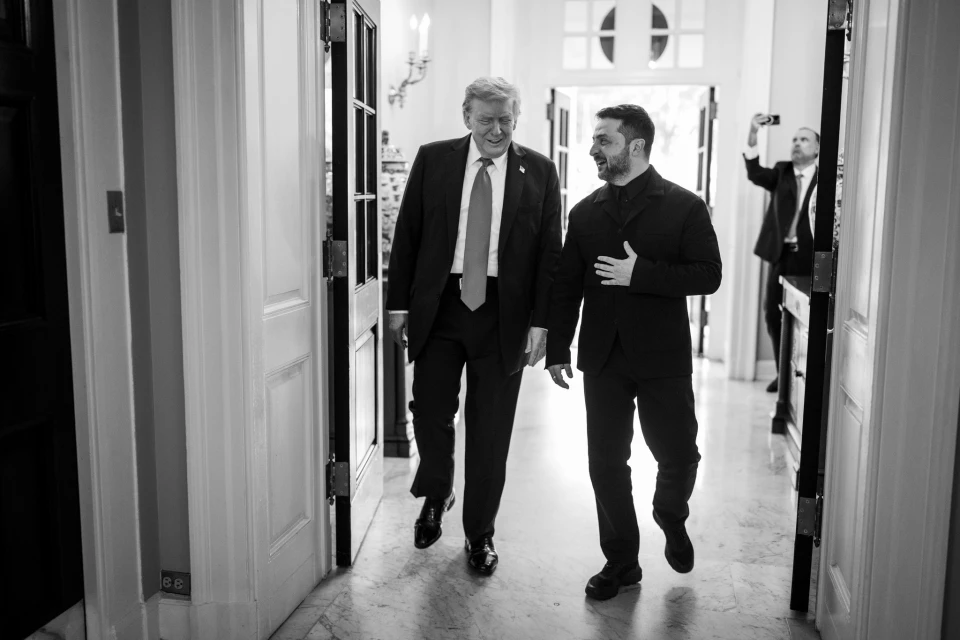
The meeting in Washington on August 18 between Trump and Zelenskyy
photo: The White House
International media are responding cautiously to the meeting’s results. ABC News notes that “key questions remain unanswered,” emphasizing that while Trump promised to “help protect Ukraine,” the specific measures have not yet been detailed.
The Guardian also writes that although the need for guarantees for Ukraine's security has been agreed, "the details are unclear."
And Reuters also says that the "well-mannered White House welcome for Ukraine leaves many questions."
"Additionally, it is unclear how much a principal-level meeting would actually advance the cause of peace. The gulf between the Russian and Ukrainian positions is vast," the outlet notes.
CNN wrote that this "historic day" was reminiscent of the great political gatherings that ended World War II and built the modern world.
"It was the best day Ukraine has had in a very long time. But it’s still hard to see how the war unleashed by Russia’s brutal invasion ends any time soon," the media says.
As political expert Michael Kimmage of the Wilson Center told CNN, we are now watching everyone "seems a party to fantasy diplomacy, — I don’t think it is sustainable." That is, the U.S. president continues to juggle various meetings that he calls a breakthrough in the resolution of the war, but "there are no details to what is happening. It’s all promises, and the promises on the surface contradict each other."
Politico writes that President Trump wants rapid progress towards peace, but Ukraine is looking for real security guarantees. It also notes that "the transatlantic alliance is holding up" as long as Trump is ready to join the security guarantees.
"In sum, it was a bad day for Putin with Western unity renewed and the U.S. back in the fold," a British official present at the negotiations told Politico.
The New York Post talks about "positive signs for peace" after the Washington meeting, but emphasizes that Donald Trump still needs to put pressure on Putin.
As Der Spiegel concludes, although the risk of a split was high, in the end, "Europeans simply felt relieved" after the meeting with Trump ended.
"The Europeans went to Washington for the Ukraine summit with some nervousness. But their appearance with the U.S. president matters: the result is not a dictated peace, but rather the hope for the beginning of a peace process," the publication writes.
Ukrainian MP Yaroslav Zheleznyak aptly summarized the Washington meeting:
“In short, from what I saw: we agreed to a meeting with Putin without conditions, but the timing is still unknown. It seems everyone agreed on security guarantees, but the exact details are still unclear. We don’t know if Russia’s position on ending the war has changed, nor if the partners share a common stance on the terms for ending the war—it seems they do not. Most importantly, what will happen if the trilateral meeting between Putin, Zelenskyy, and Trump falls apart is unknown.”
Viktor Shlinchak, chairman of the Institute of World Politics, wrote that Trump’s mood can change at any moment, so the current position of the U.S. president should not be overestimated.
"The most important factor in the negotiations that is currently working remains the ability of our Armed Forces to deter the enemy. Everything else is fiction that works poorly or not at all at this stage," the expert believes.




- News