


Map of military operations: frontline threats and prospects in 2026



Last year, Moscow failed in virtually all of its plans, both in Donetsk Oblast and in Zaporizhzhia, Kharkiv, and Sumy Oblasts. But as the negotiation track shows, Putin has not given up on an offensive in 2026. What are the biggest threats and challenges to Ukraine's defense in the new year, and how can we overcome them?
Prospects for an offensive on Zaporizhzhia
After the breakthrough toward Huliaipole, Russian generals told Putin something that made him once again announce a major offensive on Zaporizhzhia on the eve of the new year. Indeed, throughout last year, the Russian army inched closer to the regional center meter by meter, approaching it by 5 km during this time. Since August, the battle has been ongoing for the small town of Stepnohirsk, which stands in the way of a deeper breakthrough toward Zaporizhzhia. Although part of the town is already under Russian control, the Defense Forces still control most of its districts. However, Russian forces are trying to bypass Stepnohirsk from both flanks. Their assault groups are pushing through Prymorske 8 km from Zaporizhzhia, all the way to the Konka River.
Actually, whatever Putin and his generals may say, the full capture of this territory up to the Konka and creating more favorable conditions for shelling the southern districts of Zaporizhzhia is the maximum that the invading Russian troops can count on this year. However, even this is quite significant, because part of the city could turn into ruins, as has already happened with Kherson or the northern outskirts of Kharkiv.
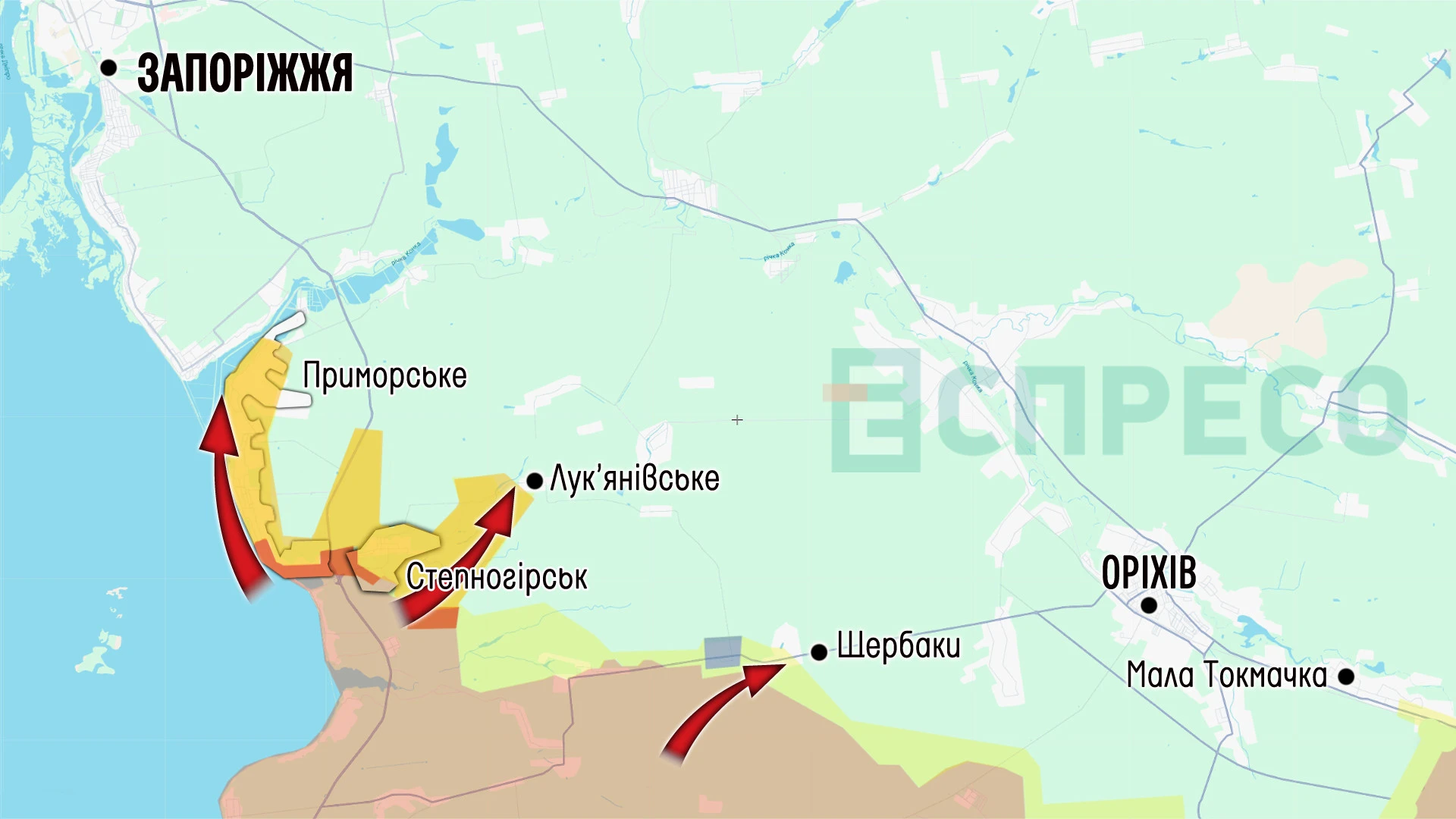
From the other flank of Stepnohirsk, the gray zone has expanded 6 km toward Lukianivske, and if it continues to expand eastward, this will become a major problem, as Russian forces will be able to get behind Ukrainian defense lines in the Orikhiv direction.
However, this is a distant prospect because right now, despite Russia directing new reserves to this section of the front, the intensity of fighting here, as throughout last year, remains one of the lowest, and Stepnohirsk is still holding its defense.
Meanwhile, the Huliaipole front has become so intense in recent weeks that it has equaled Pokrovsk, which for almost the entire year had a significant lead in this regard. The Russian army has thrown additional forces here to turn the situation around and completely capture the city. But the Defense Forces have also pulled reserves here, which allowed them to stop the invaders along almost the entire breakthrough line. As a result, Russian forces are not only conducting street fighting, but also looking for new gaps in Ukrainian defenses. Their main goal is to get into the flanks, and even better, behind Ukrainian defensive lines, one of which stretches from Orikhiv to Huliaipole, and another from Huliaipole to Pokrovsk, along the Haichur River.
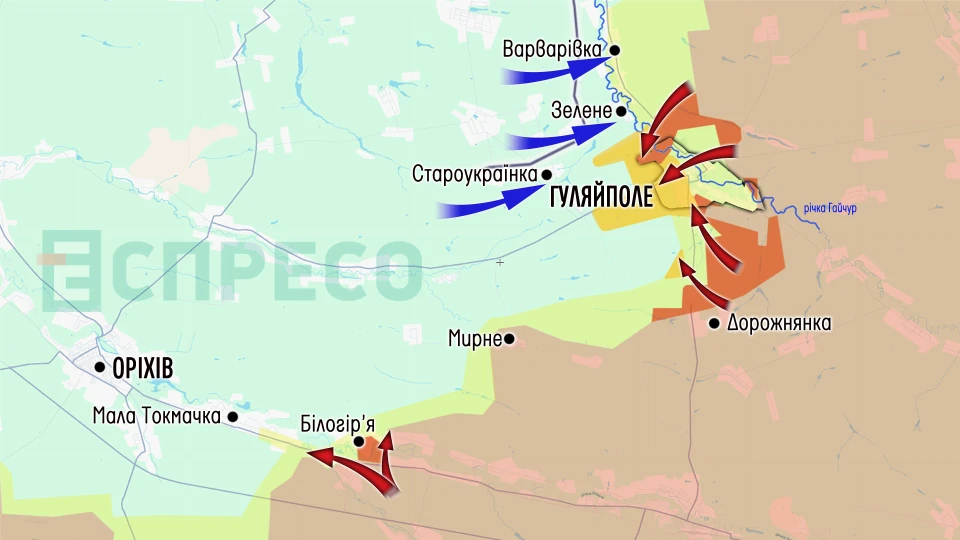
The problem is that on the southern outskirts of Huliaipole, particularly in the Dorozhnianka area, the Russian troops have already crossed the river and are moving north along its right bank. Thus they are bypassing the defenders in Huliaipole and want to encircle them through Zaliznychne. Already now, Ukrainian assault groups are clearing Varvarivka, Zelene and Staroukrainka of Russians who have penetrated there. They are also trying to break through Ukrainian defenses in Bilohiria.
The threat of being outflanked is quite real, as is the continuation of Russian advancement north and west beyond Ukrainian defensive positions. Finding a solution to prevent the collapse of the front in the Zaporizhzhia region and, as a consequence, its spread to the Dnipropetrovsk region, is the greatest challenge for the General Staff in 2026.
After Pokrovsk, Kostiantynivka will be held defense
Meanwhile, in the Donetsk region, one of the longest battles of this war is coming to an end. The positions held by the Defense Forces in Pokrovsk and Myrnohrad are becoming fewer each day, and the intensity of fighting is gradually fading.
Ukraine holds the northern districts in both cities, but their fate is being decided in flank battles for Hryshyne, Rodynske and Chervonyi Lyman. This is where the Russians are now directing their main efforts.
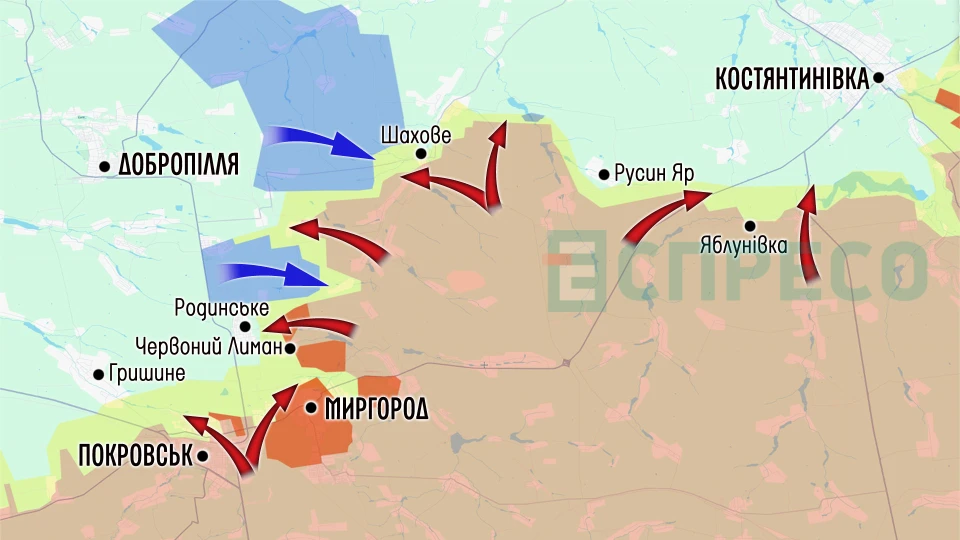
The withdrawal of Ukraine's Armed Forces from Pokrovsk and Myrnohrad is a matter of the coming months, and therefore the question already arises as to which direction the hundred-thousand-strong invading army will be directed, whose priority task is to capture all the Donetsk region. Whether they will first go to Dobropillia, or immediately focus on breaking through toward Druzhkivka to take Kostiantynivka in pincers, is currently unknown.
Let's hope that the greedy adversary, as it often does, will take a third path and disperse its efforts between Dobropillia and Druzhkivka, which will give Ukraine time for a worthy defense.
In any case, 2026 will be the year of battle for Kostiantynivka at minimum, and for Sloviansk at maximum.
Already now, Russian assault groups are constantly running into the southeastern districts of Kostiantynivka, but so far the Ukrainian defense here is holding firm. Attacks from the east look more threatening. Chasiv Yar has been covering the city from the flank for the second year, but this will not last forever.
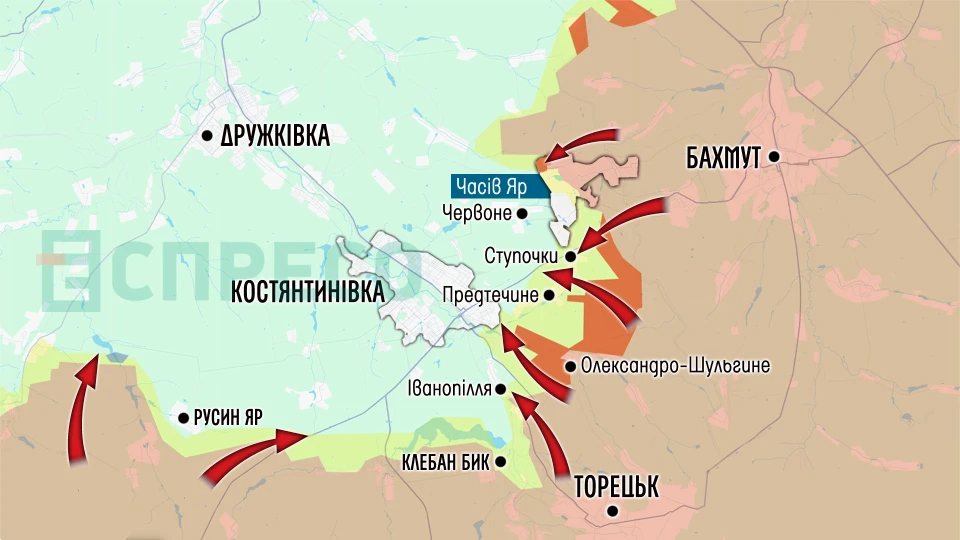
Russians are constantly trying to break through between Chasiv Yar and Kostiantynivka, storming Stupochky and Predtechene and have some minor advancement here. In the coming months, their breakthrough to Chervone and the encirclement of Chasiv Yar's defenders will be a priority task. And we can see that the intensity of fighting on this section of the front is constantly growing. Kostiantynivka should already be ready for all-around defense and street fighting now, so as not to repeat the fate of Myrnohrad, whose defense could have lasted much longer if the logistics had not been cut off.
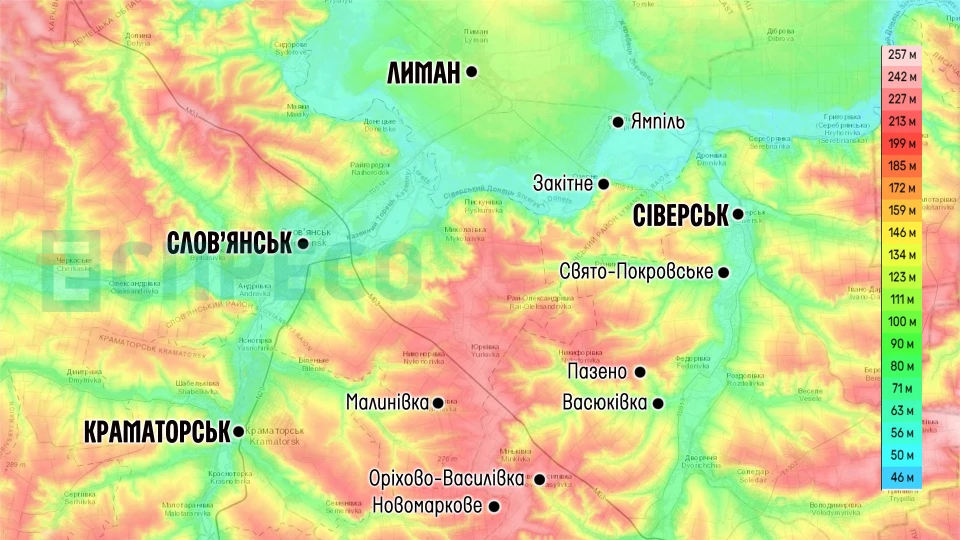
After the rather quick fall of Siversk, the Russian army will break through to Sloviansk and Kramatorsk and prepare to storm these cities. First of all, Sloviansk, since attacking Kramatorsk without capturing Kostiantynivka, Druzhkivka and Sloviansk is a futile endeavor.
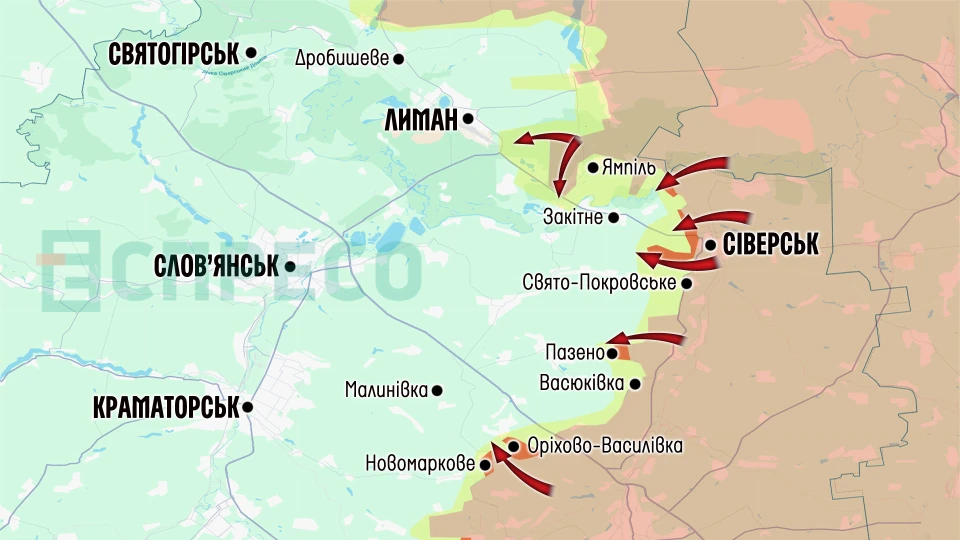
Therefore, Russian forces first need to capture the heights that stretch along the Siverskodonets-Donbas canal, and then, after prolonged shelling of the cities, force the canal itself. This is all quite a lengthy process that could stretch over the entire year, or even longer.
Kharkiv region has time to prepare
After the second liberation of Kupiansk, the situation in the Kharkiv region has stabilized. Russian attacks have decreased both near Vovchansk and on the border north of Velykyi Burluk. While Ukraine's Armed Forces are completing the clearing of Kupiansk, the Russians are nervously trying to return to the approaches to the city, but all their assaults are failing.
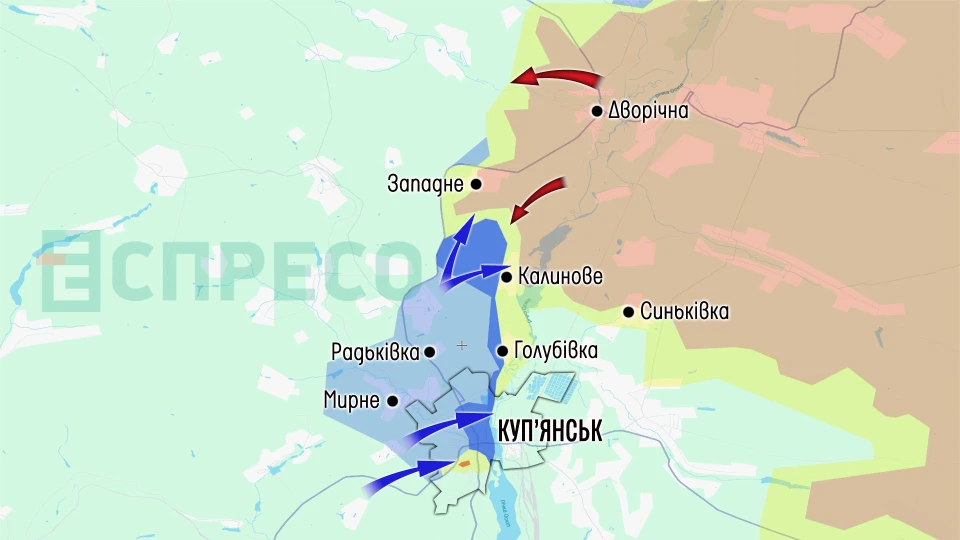
Meanwhile, Ukrainian forces continue their counteroffensive north along the Oskil and have regained control of part of the territory near the village of Zapadne. It is likely that Ukraine's main goal is to use several months of time, while Russian forces recover from defeat, to push them as far as possible from the city and possibly regain control of the fortified area in Dvorichna. However, already in March-April, the Russians will return to the idea of capturing Kupiansk. So Ukraine needs to prepare for this.
What to expect in 2026
In 2026, Ukraine's Armed Forces must solve two main tasks. The first is to be able to accumulate reserves more quickly.
It is precisely due to their absence that Ukraine lost Siversk and is now losing Huliaipole. One option for such a solution is to scale up ground drones, which can partially replace infantrymen on the front line.
Secondly, but no less important, is to find countermeasures to infantry breakthroughs. Already now, a partial countermeasure has been found. Kupiansk has demonstrated this. Although, the method is kept secret. However, it is obvious that one of the components of success will be a drone line. This is indicated both by personnel changes in the power bloc of the Cabinet of Ministers and by the results of the work of Ukrainian drone units.
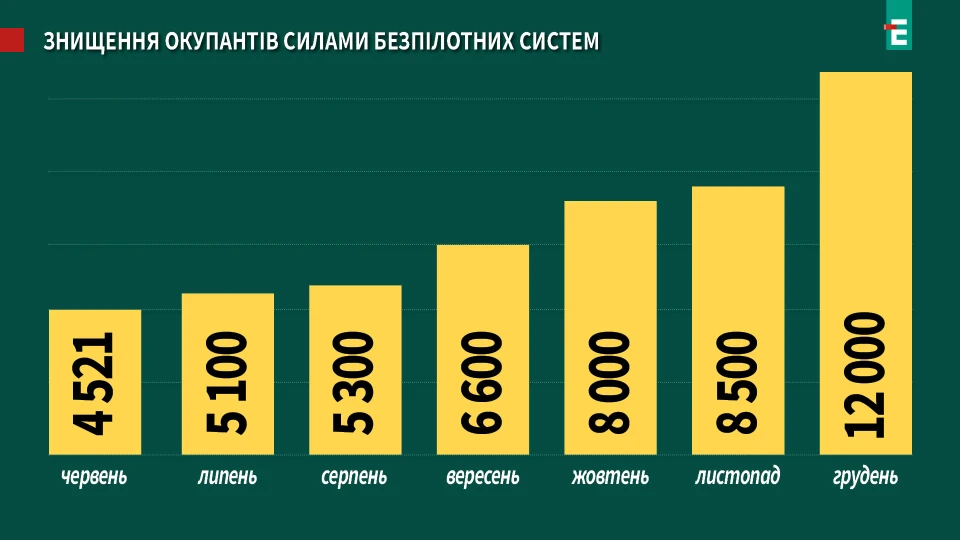
The Unmanned Systems Forces have been increasing their effectiveness monthly since June and set a new record in December, hitting over 12,000 Russian assault troops. Interestingly, overall, Ukrainian drone units destroyed more than 33,000 Russian servicemen in December. And this is only based on video evidence. In reality, it's more. Therefore, the General Staff's data on 35,000 destroyed adversaries by all Defense Forces is significantly underestimated. Because all Ukrainian artillery, aviation, all mortar crews and riflemen could not have killed only 2,000 occupiers. Something is probably wrong in the paperwork reports.
Meanwhile, the head of the Unmanned Systems Forces, Madiar, announced an ambitious plan – the elimination of 50,000 Russians by his unit alone. To achieve this, he announced the recruitment of an additional 15,000 military personnel. This looks like a good plan to stop the invaders, who are forced to announce partial mobilization to continue the offensive, and this is in conditions of serious budget problems. The other option is to reduce the intensity of combat operations and partially freeze the offensive.
The maps were created based on information received from the Ukrainian Armed Forces’ General Staff, as well as from other open and verified sources. At the same time, the maps are not maximally accurate and only conditionally reflect trends in the combat zone.




- News