


The enemy's weapon: Russian strategic rocket complex Topol-M as an argument for deterrence and threat



Topol-M is one of the rocket complexes of the Russian Strategic Rocket Forces (SRF). Its place in SRF and combat capabilities - further in the article.
As stated in Russia's military doctrine, nuclear weapons remain a deterrent to nuclear and non-nuclear conflicts. Still it is only official. As the Russian-Ukrainian war showed, Russia's nuclear weapons serve mainly to deter NATO from punishing the Russian Federation for its aggression, as well as to intimidate the victim countries.
Russian Strategic Nuclear Forces
The main contribution to Russia's deterrence (and intimidation) potential is made by strategic nuclear forces (SNF), which include land-based missile defense forces (missile forces of strategic purpose, - ed.), naval and aviation SNF of the Russian Armed Forces (RAF). The SNF also has backup forces and interacts with the missile attack warning system.
The SRF forms the basis of the SNF. The RAF includes 3 rocket armies (RA) with 12 rocket divisions (RD), but only the 27th RA (its 54th and 60th RD) has Topol-M rocket launcher.
In total, the 27th Guards Vitebsk RA (Volodymyr-21) includes 5 RD, management and support centers.
In the 54th Guards RD (Ivanivska region, Teikovo-6) there are 4 rocket regiments RRs (235th and 321st RR with 9 self-propelled launchers of mobile ground-based missile systems (PGRK) Topol-M each; another 2 RRs have the new Yars PGRK.) Also, the division has a control system, a technical rocket base, a mobile spare СP, a control and communication equipment regulation group, an operational and technical commandant's office, 5 separate battle units (combat support with communication, security and intelligence, automotive, material and technical support, medical), technical control unit, training group and postal communication station.
In the 60th Tamanska RD (Sarativska region, Tatyshchevskyi district, Svitlyi village), there are six RRs (31st, 86th, 104th, 122nd, 165th, 271st), with 10 missile launching facilities (MLFs) Topol-M RS each. Besides, the division has management and support units, as in the 54th RD.
In total, the SRF has 78 LFs Topol-M RS (18 PGRK and 60 LFs). It is planned to keep the MLF missiles on duty until 2030, and replace the PGRK with Yars.
The SRF has 338 combat RSs (in addition to 78 "Topol-M", another 18 "Topol", 162 "Yars", 30 "Yars-M", 4 "Avangard", 46 "Voevoda"). Hence, RS "Topol-M" makes up 23% of the missiles of the SRF, which is still quite a lot
Topol-M RS: history and characteristics
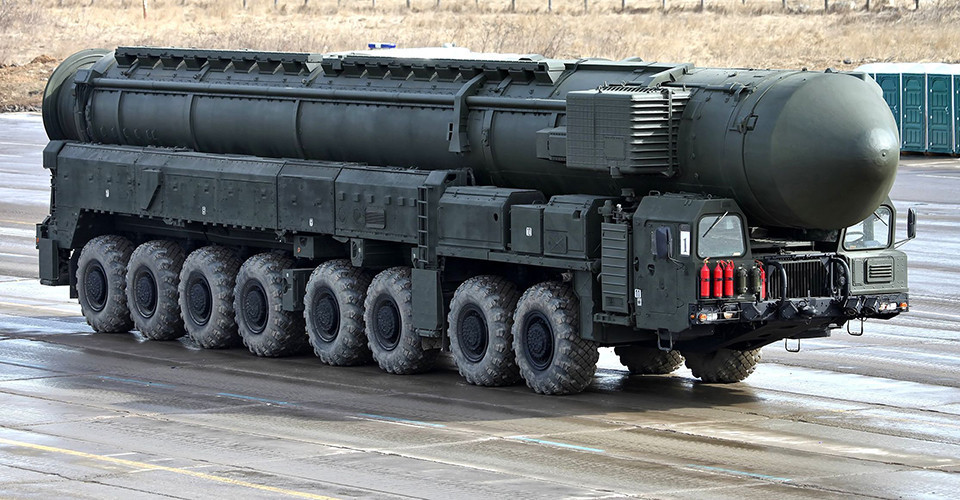
Topol-M RS was developed at the Moscow Institute of Thermal Engineering on the basis of PGRK Topol (and to replace it), missiles were produced by the Votkinskyi plant. Designation of RS - RT-2PM2, missile index PGRK 15P155 (missiles with LFs - 15P165), code CHO PC-12M2.
RS testing was conducted at the Plesetsk Cosmodrome, 18 launches were carried out in 1994-2019 (including 17 successful ones). RS for MLFs has been serially produced since 1997, and is in service since 2000. In 2011, the Ministry of Defense of the Russian Federation refused to purchase Topol-M RS in favor of the deployment of the more effective Yars RS, which has an ICBM with multiple warheads of individual targeting.
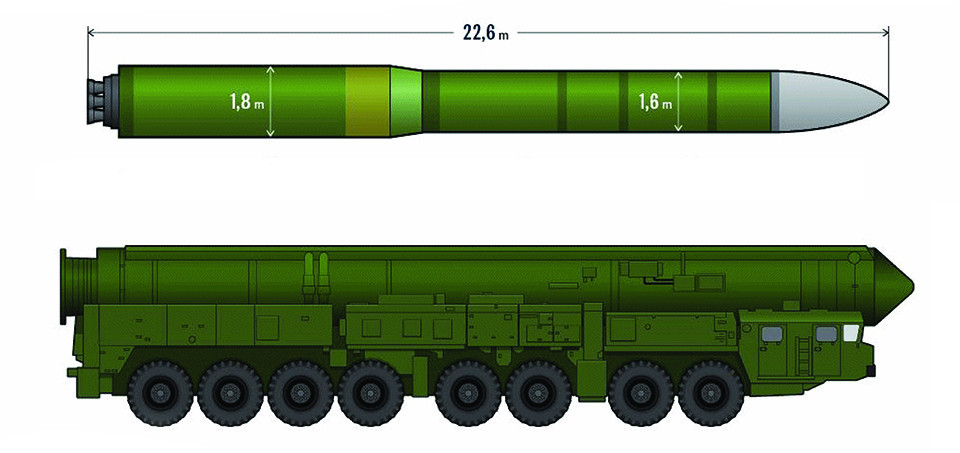
Rockets are launched mortar-style. A solid-fuel engine allows gaining speed faster than previous types of USSR missiles of the same class. This makes it difficult to intercept them by missile defense facilities in the active part of the flight.
Intercontinental ballistic missile (ICBM) Topol-M RS is a three-stage one. Its length with MP is 22.55-22.7 m, (without MP 17.5 m), diameter 1.81 m, weight 46.5 -47.1 t (thrown-weight 1.2 t).
The ICBM launch range is 11,000-12,000 km, the separable MP carries 1 thermonuclear warhead of 1 Mt. The guidance system is an autonomous inertial one based on the BCRC, probable circular deviation (PCD) of MP is 150-200 m. The MP allows hitting any small-sized, high-strength strategic targets (CP, communication hubs, ammunition storage).
The complex of missile defense penetration aids has passive and active false targets, means of changing the MP indicators. The latter consist of a radio-absorbing coating, generators of active radio interference, sources of infrared radiation with a sodium-lithium mixture and dipole reflectors. Dozens of auxiliary correction engines, instruments and control mechanisms allow the missile to maneuver on the trajectory, making it difficult to intercept it in the active stage.
The missile defense system has 15-20 small atmospheric false targets with an application height of 2-5 km and a mass of 5-7% of the MP mass. False targets do not differ from MP in all ranges of electromagnetic radiation; it allows simulating the characteristics of the MP in all respects in extra-atmospheric and transitional parts, as well as in the part of the atmospheric section of a downward trajectory of the MP. Also, MP and false targets are resistant to nuclear explosion and powerful laser beams.
For comparison, the old Topol RS has a range of 10-11 thousand km, no missile defense penetration aids and a 0.55 Mt MP.
LF Topol-M PGRK on the chassis of an 8-axle tractor 16x16 MZKT-79221 (MAZ-7922) has a carrying capacity of 80 tons. Its weight without a missile is 40 tons, speed - 45 km/h, range - 500 km. RS has already ceased to be produced, and the Topol-M PGRK has almost been replaced by the Yars PGRK. In 2022, according to the state defense order, it is planned to receive up to 18 Yars ICBMs.
Conclusions:
1. The Topol-M RC missile can destroy a large city in Ukraine and contaminate a large area with radiation, but these missiles are intended only for strategic nuclear deterrence of the United States.
2. The US national missile defense system is designed to intercept single ICBMs and protect against their accidental or unauthorized launches, as well as against the imperfect missiles of North Korea and Iran. In principle, the Topol-M ICBM can be intercepted by the RS, but the number and proportion of downed missiles will be very low. The ground-based missile defense complex of the US (GBMD) for intercepting ICBMs in the middle part of the trajectory has only 44 GBI anti-missile launchers. In addition, the missile defense penetration aids of Topol-M missiles significantly complicates the interception.
3. As for the Kremlin's threats to use nuclear weapons against Ukraine, these are only threats of extremely small probability. However, after February 24, everything is possible. But in any case, these may not be ICBMs of Topol-M RS with a 1 Mt warhead, but BMs of Iskander-M TBMS with a warhead of 50 kT. However, we hope that Putin will not dare to do this, because Russia will be treated like a rabid dog afterwards.




- News