


How new Atlantic Charter between U.S. and U.K. will affect world and Ukraine



During Donald Trump’s UK visit, much attention focused on the grandeur of the royal reception. Yet even more significant was the extensive package of technology agreements signed during the visit. In terms of impact, these accords can be compared to the Anglo-American Atlantic Charter of World War II and could have far-reaching implications for the global order
Contents
1. What is included in the large American-British technology package
2. How the package shapes the nuclear energy of artificial intelligence without Russian fuel
3. Algorithmic lethality and human in the loop: technologies in U.S.-UK defense cooperation
Donald Trump’s visit to the UK involved more than politics and ceremonies. Leaders of major U.S. companies came to London to witness the signing of a framework agreement on a major U.S.-UK technology cooperation package, including substantial public and private investments in AI, quantum technologies, and nuclear energy in the UK by American firms.
This package could likely have been signed without top officials and with minimal media coverage, as it had been long prepared and ready for implementation. However, Donald Trump chose to make it a central focus of his second state visit to the UK. This reflects not only President Trump’s political priorities but also U.S. policy that can persist regardless of who is president.
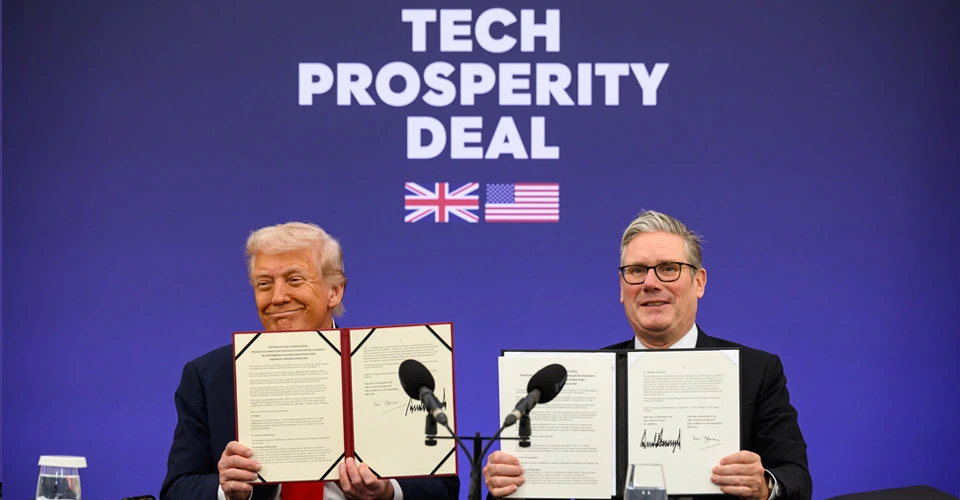
The Atlantic technological rapprochement is happening independently of the U.S.’s important Middle East dynamics. Unlike the U.S., the UK has recognized Palestine as a sovereign state and condemns Israeli military operations on what is now considered Palestinian territory by the UK. Prime Minister Keir Starmer publicly announced the recognition of Palestine in Trump’s presence in London. Yet this has had no impact on the prospects for American technologies in the UK.
Thus, the technology package brought by Donald Trump transformed the event from a ceremonial spectacle into a demonstration of the enduring special relationship between the U.S. and the UK, which will significantly shape the new world order.
What is included in the large American-British technology package
The total announced investment in the technology agreement signed by Donald Trump and Keir Starmer exceeds $40 billion. This amount currently covers information technology projects, though the agreement is not limited to this sector.
- Microsoft: $30 billion to develop AI and data centers in the UK by 2028.
- Alphabet (Google): $6.8 billion for research and engineering in the same field.
- Nvidia and OpenAI, together with UK-based Nscale, are launching the Stargate UK project in Northern England — a supercomputer and data center network providing advanced computing power for scientific and military purposes.
- CoreWeave: plans to invest £1.5 billion in AI data centers.
- Salesforce: over $2 billion by 2030 in the UK’s IT sector.
- BlackRock: more than $500 million in new infrastructure.
 Palantir Technologies has signed a strategic partnership with the UK Ministry of Defence. The British government will provide contracts worth £750 million over five years. Palantir plans to invest £1.5 billion in UK assets, including establishing a European headquarters for its defense business in London and creating over 350 new jobs.
Another key focus is nuclear energy. While specific investment amounts were not disclosed, the main idea is that the UK, using a new generation of nuclear reactors, will be able to generate sufficient electricity without any Russian involvement in the nuclear fuel cycle. Currently, Russia still holds a significant share of the global isotope enrichment market. For the UK, following the U.S., this dependence on Russian nuclear services is coming to an end, with the “nuclear break” expected by 2028. The technology agreement includes U.S.-UK alignment of regulatory approaches, faster licensing of new reactors, and market access.
The new Atlantic technology package is more than a single project — it marks a U.S. geopolitical push toward Europe, with technology as a key tool for development and global influence. At the signing ceremony, attended by U.S. and UK companies, Donald Trump joked to NVIDIA CEO Jensen Huang: “This will create new government, academic and private sector cooperation in areas such as AI, which is taking over the world... I'm looking at you guys. You're taking over the world. Jensen, I don't know what you're doing here” The audience laughed, but the joke revealed a deeper truth.
| Company | Project | Declared Investments | Source of Investments |
| Microsoft | AI infrastructure, data centers, R&D | $30 billion | Corporate capital, government incentives |
| AI R&D and engineering | $6.8 billion | Corporate capital, R&D grants, research partnerships | |
| Nvidia, OpenAI, Nscale | Stargate UK — supercomputer, data centers | Infrastructure commitments | Corporate capital, joint private investment |
| CoreWeave | Data centers for AI | £1.5 billion | Corporate capital, project financing, government incentives |
| Salesforce | Business expansion/cloud services | £2 billion | Corporate capital, government infrastructure investments |
| BlackRock | Infrastructure investments | £500 million | Private investment funds, infrastructure funds |
| Palantir Technologies | Strategic partnership with the UK Ministry of Defense | £750 million in contracts + £1.5 billion in corporate capital | UK defense budget, corporate capital |
| X-Energy | Industrial modular nuclear reactors | ~12 reactors in Garthpool (media estimates) | Private investment, project loans, government support |
| Holtec International, EDF UK | Small modular nuclear reactors | Parameters not disclosed | Corporate capital, project financing, possible government investment |
| TerraPower, KBR | Engineering and support for new nuclear reactors | Parameters not disclosed | Corporate contracts |
| Centrus Energy (HALEU) | Enriched uranium production | Parameters not announced | Government grants and fuel contracts, corporate capital for construction |
| Urenco | Nuclear fuel production | Parameters not announced | Corporate capital, public-private partnership |
How the package shapes the nuclear energy of artificial intelligence without Russian fuel
The UK has committed to completely phasing out nuclear fuel produced with Russian involvement by the end of 2028. Until now, Russia accounted for 40% of the world’s isotope enrichment for nuclear fuel. This situation arose from U.S.-Russian agreements in the early 1990s, which allowed the Russian nuclear industry onto the global market with significant amounts of uranium for nuclear fuel, sourced from surplus weapons-grade uranium.
The UK’s exit from Russian nuclear dependence, following the recent U.S. move, involves several levels.
First, the plan involves expanding UK uranium enrichment and fuel fabrication capabilities. The UK-Netherlands-Germany consortium Urenco has announced investments in new production lines for “advanced fuels” for next-generation reactors.
Second, the UK market is opening to U.S. nuclear energy companies. X-energy plans up to twelve Xe-100 small modular reactors in Hartlepool; Holtec International, together with EDF and Tritax, is advancing a small modular reactor (SMR) project in Nottinghamshire; TerraPower and KBR are competing for engineering contracts. All these projects aim to produce nuclear fuel without Russian involvement.
A separate issue is high-assay low-enriched uranium (HALEU) for next-generation reactors — uranium enriched in U-235 above standard commercial levels but below the threshold for highly enriched uranium. Currently, only Russia has large-scale production capacity for HALEU. The U.S. is now restarting HALEU production: Centrus Energy has received contracts from the Department of Energy and is already producing industrial volumes. Under the Trump-Starmer agreement, the UK will be able to receive this new American fuel for next-generation small modular reactors and industrial reactors powering industrial clusters.
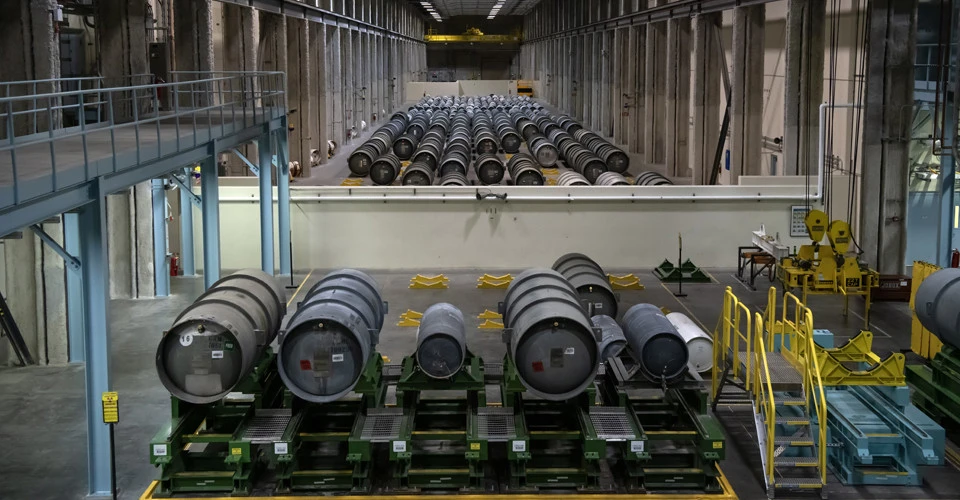
Thus, phasing out Russian fuel brings the UK in line with the U.S., which in 2024 passed a law banning imports of Russian-enriched uranium, with transitional exemptions until 2028. Therefore, 2028 becomes the point of synchronization for the U.S.-UK exit from Russian nuclear services.
Algorithmic lethality and human in the loop: technologies in U.S.-UK defense cooperation
Palantir’s package of agreements and commitments in the UK has a distinct military focus. The framework agreement between Palantir and the UK Ministry of Defence, signed alongside the intergovernmental technology deal, includes potential contracts worth around £750 million over five years. Separately, the company has pledged up to £1.5 billion to establish a European headquarters for its defense business and expand its presence in London.
The agreement includes localizing research and development in the UK, creating several hundred new jobs, and deploying operational infrastructure to support the company’s products and services. This localization is intended, in part, to reduce political resistance in the UK to using foreign information products in critical defense infrastructure.
Palantir will provide modules for building a common operational picture (fusion layer) that aggregates and correlates multi-source data. This includes AIS (Automatic Identification System), ADS-B (aircraft surveillance), radar signals, satellite imagery, ISR (Intelligence, Surveillance, Reconnaissance) drone feeds, HUMINT (human intelligence) and ELINT (electronic intelligence), as well as logistics and medical data. The platform transforms disparate signals into actionable situational awareness with task prioritization.
Palantir’s information solutions in the UK will be integrated into the “Digital Targeting Web” — the British national digital ecosystem that connects sensor networks with fire-control channels. This infrastructure is designed to drastically shorten and accelerate the kill chain, the sequence of steps from target identification to destruction. The U.S. and UK view this as a key element for modern warfare, alongside speeding up supply cycles from concept to frontline weapon deployment in new defense production.
Palantir’s operational model shortens the time to turn data into decisions: target identification → prioritization → resource allocation → task generation for engagement. This increases operational tempo and reduces human involvement in critical processes. Effectiveness is measured by “algorithmic lethality,” where battlefield advantage comes less from the number of weapons or personnel and more from the efficient use of available resources.
The main UK concern regarding the strategic defense partnership with Palantir relates to entrusting a critical command-and-control layer to a foreign private company, creating dependence on access to data and algorithms and complicating oversight of decision-making logic. Another key aspect is ethical and legal responsibility: who is accountable when decisions on the use of force are made or supported by automated processes.
To minimize these risks and reduce political resistance, the Palantir agreement with the UK Ministry of Defence includes significant localization of American technologies. This involves British personnel at the company’s London headquarters, engagement of UK contractors, data protection agreements, and adherence to the “human-in-the-loop” principle in implementing Palantir’s combat management products.
The U.S.-UK technology package signed during Donald Trump’s second state visit can be compared to the Anglo-American Atlantic Charter signed aboard a warship in August 1941. That charter shaped a shared vision of victory in World War II and laid the foundations of a world order that secured the Western win in the Cold War. Then, the focus was on resources; now, it is on technology.
For Ukraine, this could mean the following: artificial intelligence, which will soon be able to take on a significant share of command and control for U.S. and UK forces, requires training. Ukrainian experience is critically important for this training, offering opportunities for accelerated technological development.
Additionally, powering the new information systems requires energy, and the new Atlantic consensus points to next-generation small nuclear reactors as the source. Ukraine possesses significant uranium reserves — still inaccessible to Russia and China — along with scientific potential, research infrastructure, experience in operating nuclear facilities, skilled personnel, and an education system. This gives Ukraine strong opportunities to develop within the world’s new technological paradigm.
This material was prepared in collaboration with the Consortium for Defense Information (CDI), a project that unites Ukrainian analytical and research organizations and aims to strengthen informational support and analytical capabilities in national security, defense, and geopolitics.




- News