


Russia’s 2003 Tuzla Island grab: rehearsal for war on Ukraine



Russia began preparing for war with Ukraine 22 years ago, during the conflict over Tuzla Island. On September 29, 2003, Moscow launched the active phase of building a dam toward the island. The standoff lasted 25 days, from September 29 to October 23, 2003
Read the review to find out what conditions led to it and how this stage of the confrontation ended.
Russia had been planning to seize Ukrainian Crimea long before the 2014 invasion, and in the early 2000s it even provoked a conflict over Tuzla Island. At that time, Russia was testing the reaction of the Ukrainian authorities and the international community to a potential territorial dispute.
On September 18, 2003, the administration of Russia’s Krasnodar Krai made a so-called “technical” decision to build a dam in the Kerch Strait. The official reason given for the works was supposedly a flood that caused numerous casualties and destruction in the Temryuk district, while the dam in the Kerch Strait was intended to protect the land from erosion.
There were also semi-official explanations for the conflict, which Russian propaganda actively promoted in the Ukrainian information space — political and economic.
Beginning of the Russian operation
On September 27, Ukrainian border guards recorded boats approaching the fishing pier on Tuzla Spit, with two Russian reporters from the NTV channel on board. They were asking locals about their attitude toward joining the island to Russia. By September 29, Russia began the active phase of constructing a dam to Tuzla. The next day, Ukraine’s Foreign Ministry sent its first note of protest, which went unanswered.
On the same day, the Russian Security Council held a meeting on “forming a new program for the protection and defense of borders as a priority of the current time,” discussing the delineation of the maritime border with Ukraine — a move that was, in essence, an attempt to officially deploy Russian security forces onto Ukrainian territory, wrote Army.Inform.
Lieutenant General Mykhailo Koval, then First Deputy Head of the State Border Guard Service of Ukraine, recounted in an interview with Ukrainska Pravda that he sent “300 Spartans” to Tuzla — the nickname he gave the first Ukrainian border guards who arrived on the island. Koval ordered the heads of five regional Border Guard administrations to select 30 fit men each, skilled in hand-to-hand and firearms combat, and send them to Tuzla. To avoid panic, he sent a document to the administration claiming that a hand-to-hand combat competition was being held in Kerch for the Border Guard championship.
“I acted at my own risk. I had no orders (to prepare for armed resistance), but the law on the state border clearly states that we have the right to use weapons,” he said.
At the time, Ukrainian President Kuchma was abroad, the Head of the State Border Guard Service, Mykola Lytvyn (brother of the then-Speaker of the Verkhovna Rada), was also away, and his deputy Shysholin, responsible for border protection that day, was on vacation. Koval was only able to reach the Head of the Presidential Administration, Viktor Medvedchuk, who hung up. All decisions were made by Koval himself, and when Mykola Lytvyn returned and requested that the border guards be removed from the island, he asked for a written order, which never arrived.
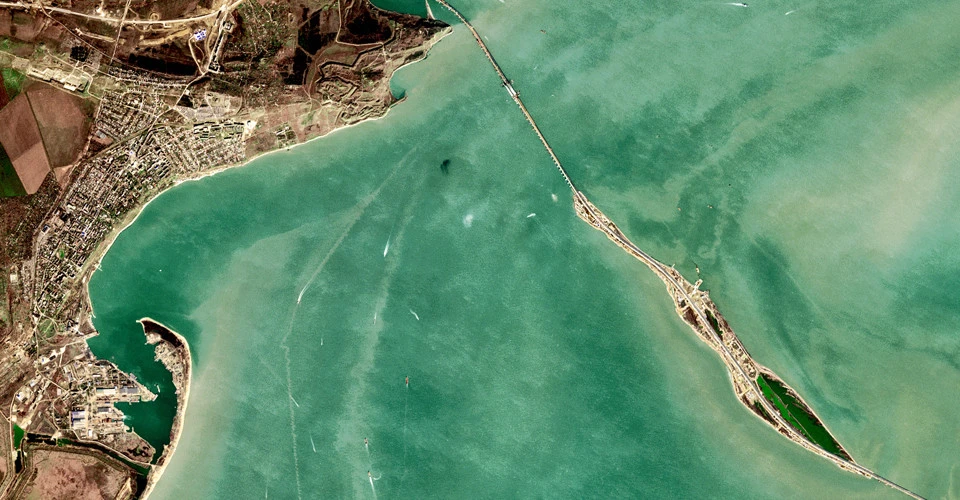
Tuzla Island, photo: Getty Images
Defense of Tuzla
The Russians worked on the dam in three shifts, while Ukrainian border guards built fortifications and installed barriers on the island. Five pillboxes with machine-gun embrasures were erected. Ships were sent from Balaklava to Tuzla. The Kharkiv aviation squadron deployed three helicopters to Crimea, which hovered in turns over the border buoy opposite the Russian builders. The helicopters’ markings were smeared with dirt, and pilots changed jackets and helmets each rotation to give the impression that an entire helicopter regiment was present. Armored amphibious transports were disguised as tanks.
“We understood that if the Russians wanted to shell us with artillery from Kuban, nothing would remain of Tuzla. But we had to show that this is our land,” recalled the then-head of the Crimean government, Serhiy Kunitsyn.
“Tuzla was a litmus test. The Russians tested Ukraine’s strength. If we had ‘swallowed’ the expansion there, what happened with Crimea in 2014 would have happened earlier,” explained Mykhailo Koval.
Within a few days, on October 6, the then-Minister of Foreign Affairs of Ukraine, Kostiantyn Hryshchenko (currently wanted and charged in absentia for treason in the Kharkiv Agreements case), went to Moscow for talks. By that time, the dam had reached 15 km in length.
On October 22, 2003, the Verkhovna Rada held hearings on Ukrainian-Russian relations, and President Leonid Kuchma cut short his visit to Latin America to go to Tuzla and help resolve the conflict.
On the same day in Simferopol, a pro-Russian rally took place, with participants declaring their readiness to hand over the entire Crimea, along with Tuzla, to Russia. The rally was organized by pro-Russian groups Russian Community of Crimea, Russian Bloc, and the Communists.
The next day, October 23, when Ukrainian border guards and Russian builders were only about 100 meters apart, the construction was halted.
End of the conflict
According to Mykhailo Koval, President Kuchma arrived on Tuzla just before the resolution. Along with him were Presidential Administration head Medvedchuk, State Border Service head Lytvyn, and other security officials. Koval recalled that the president’s aides had not reported the situation accurately.
“They followed me into the pillbox — President and Medvedchuk. They saw five gun embrasures, each with a machine gun, grenade launchers loaded with grenades, a lot of personnel, all ready for combat. They saw it all and both of them felt uneasy,” the general remembered.
After inspecting the “hedgehog” anti-tank obstacles, mines, and warning signs in Russian, Kuchma realized the people were ready to defend their land, even in a seemingly doomed situation.
“And he immediately told Medvedchuk: ‘I’ll call Vladimir Vlasimirovich.’ He stepped aside, called Putin, spoke with him for several minutes, then returned to us and said: ‘That’s it, they’ll stop now. Let’s sit at the negotiating table,’” the report states.
Kuchma noted one key detail of the conversation: he warned Putin that he had ordered to open fire on border violators.
In November 2003, the Russian and Ukrainian prime ministers agreed to halt further dam construction.
On December 2, 2003, a new border outpost was opened on Tuzla. In July 2005, the Ukrainian Foreign Ministry announced that Russia recognized Tuzla Island and surrounding waters as part of Ukraine. However, the Russian Foreign Ministry responded that the “legal status of Tuzla Island remains unresolved.”
In March 2014, the island was annexed by Russia during the annexation of Crimea.
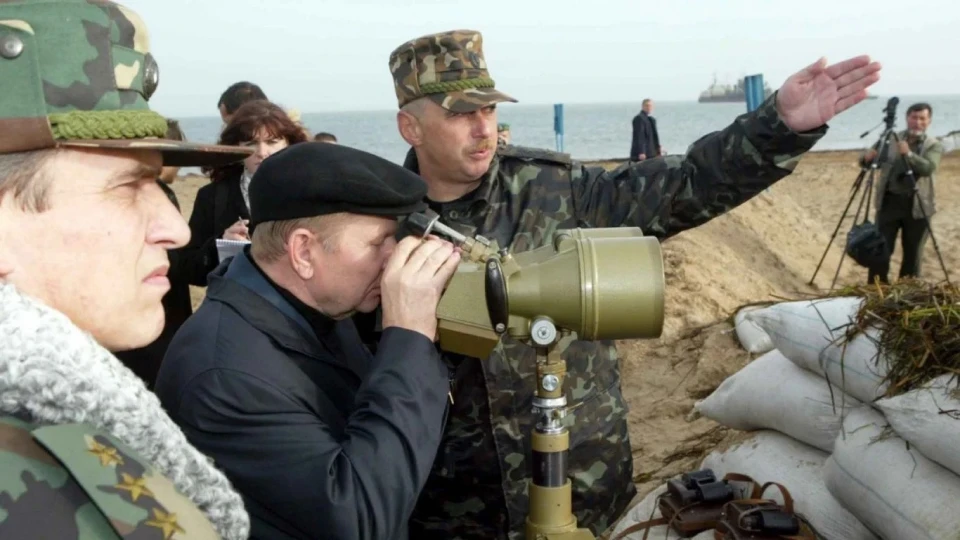
Photo: President Kuchma on Tuzla Island
For reference
Tuzla Island was formed in 1925 due to erosion from a strong storm that washed away a narrow spit extending from the Taman Peninsula (Krasnodar Krai, Russian Soviet Federative Socialist Republic (RSFSR)). The resulting island, with an area of 3 km² (length 6.5 km, width about 500 m), was transferred on January 7, 1941, by decree of the Presidium of the Supreme Soviet of the RSFSR to the Crimean Autonomous Soviet Socialist Republic, which, as the Crimean region, became part of the Ukrainian SSR on February 19, 1954.
Contrary to the documents signed in the 1940s–50s, Moscow refused to recognize Tuzla as an island, insisting it was a spit and that only the continental part of Crimea had been transferred to Ukraine. Russia also justified its stance by citing the “need to prevent erosion of the Taman Peninsula” and invoked a dubious “historical fact” claiming that “sea levels in ancient times were 4 meters lower than today,” so “Tuzla Island was a large land area and part of Taman.”
In 1997, Russia published the book Tuzla Spit: the Listed Territory, written by O. Travnikov, a deputy of the Legislative Assembly of Krasnodar Krai, professor of international law at the South-Russian Institute of International Relations, and a graduate of the KGB Higher School of the USSR.
“In politics, the small Tuzla Spit in the Kerch Strait is not a trivial matter. It is a principle. A principle of defending Russia’s national interests. And principles cannot be a subject of bargaining,” the book stated.




- News