


Why Europe can't build 'drone wall' without Ukraine



The 'drone wall' will only work if built by Ukrainian rules. European air defense systems don't work against Russia. 'Expensive and unique against cheap and mass-produced' means defeat. Ukraine has the right solutions
Contents
- How Europeans view the protection of their airspace after Russia's aerial provocations
- What Ukraine's participation in the 'drone wall' could look like
- How to integrate Ukrainian solutions into the European 'wall'
Russian drones in the airspace of Poland and Romania, MiG-31s over Estonia, and “unknown” drones over Sweden, Denmark, and Norway seem to have shaken Europe out of its complacency regarding the Moscow quasi-empire. At the same time, European politicians suddenly realized that EU/NATO defenses are not ready for the challenges and threats Ukraine has been warning about for over ten years. Only now are the first signs of constructive action appearing. The European Commission has announced plans to build a drone wall along the eastern border. The package includes creating a Drone Alliance with Ukraine and funding of €6 billion. This will allow Ukrainian ingenuity to become an advantage for Europe’s defense system against Russian drones and enable a joint drone industrialization effort with Ukraine.
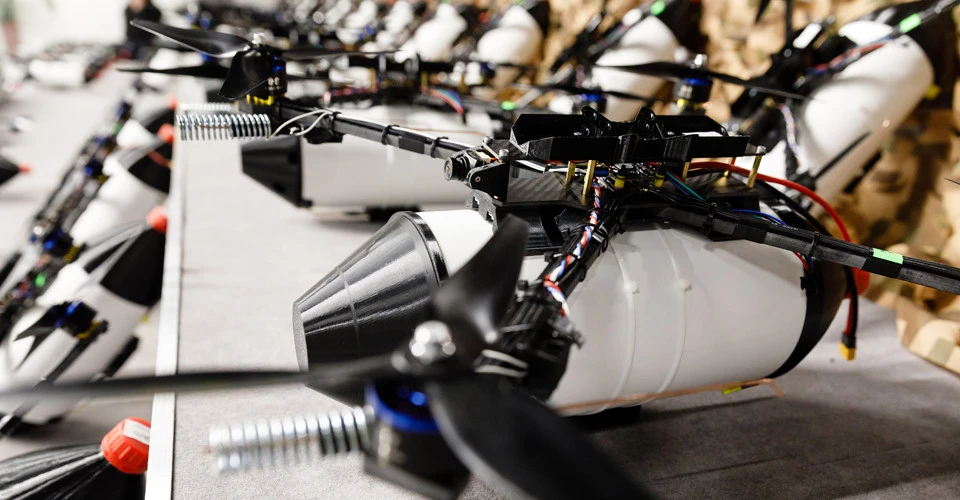
How Europeans view the protection of their airspace after Russia's aerial provocations
The logic is shifting away from old discussions about “efficient peacetime defense,” where the cost of neutralizing a target approaches the value of the target itself. Influential European outlets note that after the “incident” in Poland, the EU is accelerating investments specifically in the “drone wall,” drawing on Ukraine’s experience. At the same time, NATO is launching the “Eastern Sentinel” mission. However, this appears to be a temporary and rather unbalanced solution, unlikely even theoretically to protect European countries from hundreds of Russian drones.
At the same time, a positive shift is the clarification of the political framework for creating the “drone wall” together with Ukraine. EU Commissioner for Defence Andrius Kubilius is preparing consultations with defence ministers of the eastern EU countries on the project’s architecture — from the configuration of radar networks, other sensors, and EW capabilities to an integrated interceptor system, and on involving Ukraine as a source of technologies and tactics proven in war. In fact, this is not only a response to the Russian drone attack on Poland. The Baltic states and Finland are strengthening legal regimes for using armed forces against UAVs; Lithuania has already granted its military the unconditional right to shoot down violating drones. At the same time, European officials warn that the system will work only with unified requirements, technological compatibility and full command integration — otherwise each country will build its own defence line that is incompatible with its neighbour’s.
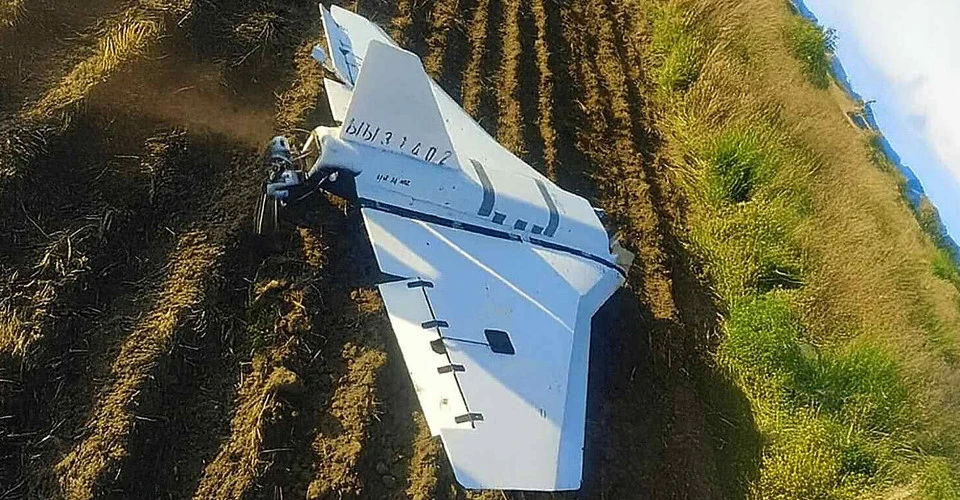
Importantly, Europe’s current air defense system does not meet modern needs. The weakness of the old model lies in the imbalance of “expensive and unique versus cheap and mass-produced.” Using advanced fighters and costly missiles against swarms of simple, inexpensive Russian-Iranian Shahed drones immediately puts Europe at a disadvantage. This gap is precisely what the EU aims to close by applying solutions that have proven effective in Ukraine. Europeans are trying to quickly increase air and naval presence and establish a dense radar network along the eastern border, where the Russian threat is constant.
What Ukraine's participation in the drone wall could look like
In the West they’ve become accustomed to the fact that the Ukrainian approach relies not on “miracle weapons” but on a streamlined creative pipeline: from frontline requests to high-tech development and serial production in a matter of weeks. A notable example is the recently announced partnership between Vyriy and The Fourth Law to mass-produce FPV drones based on the Vyriy-10 with the TFL-1 guidance module. Field experience shows a two- to fourfold increase in hit effectiveness for only about a 10% rise in unit cost. Software updates take minutes, and the module has already been NATO‑codified. These are potentially the kind of elements of the “drone wall” Europe needs: cheap, scalable, and flexible.
In Ukraine, an important component has been a system of incentives directly tied to combat effectiveness. Official "e‑points" for confirmed strikes are converted by units into purchases on the Brave1 marketplace. Thanks to this, the battlefield → production cycle is shortened to a minimum, and orders follow real results rather than presentations. Administration is provided by DOT Chain‑Defence, the Ministry of Defence’s digital supply‑chain, which reduces bureaucratic friction and speeds up the tempo.
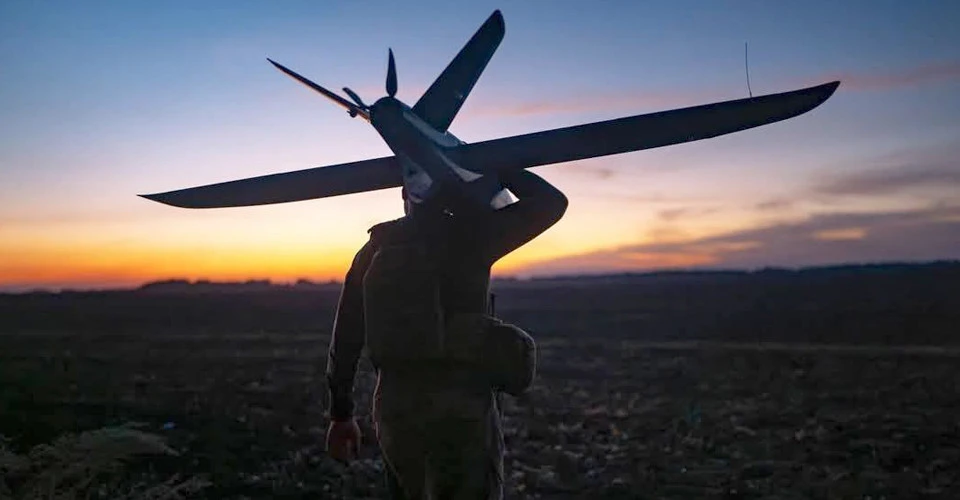
The state is simultaneously adding new types of interceptors to the system. More than twenty‑five Ukrainian interceptor drone models have already been cleared for use, some of which hunt Shahed‑type targets. The strength of the Ukrainian model lies in the diversity of platforms and the speed of their integration into the forces, rather than betting on a single “golden” platform.
Added to this are international manufacturing initiatives. The United Kingdom is beginning serial production of Ukrainian interceptor drones, with the first thousand units destined for delivery to Ukraine and further scaling for Europe’s needs. The cost of such interceptions is substantially lower than using expensive missiles against Shahed‑class targets, and the achieved effect is systemic. This is how a joint European capability can work in practice.
How to integrate Ukrainian solutions into the European 'wall'
Ukrainian experience has changed the idea of the battlefield. Tens of thousands of drones and sensors create a roughly twenty‑kilometre kill zone with a high probability of destruction, where a thermal signature, radio signal or careless movement instantly triggers a strike cycle. Traditional 20th‑century systems — columns of armor and infantry without EW protection and robotic platforms — quickly become targets. At the same time, ground robots for logistics, reconnaissance, breaching, fire support and demining are entering everyday use.
Autonomy is becoming a key performance parameter not only for drones but for other weapon systems as well. AI‑based systems independently identify targets, select trajectories and prepare strike options, leaving the human the authority to authorize engagement.
Against this backdrop, NATO and EU measures like the Eastern Sentinel, which envision deploying traditional fighters and SAMs to counter hundreds of Shaheds, look like a military anachronism and political shortsightedness — and yet another sign of the time lost since 2014, when Russia’s war against Ukraine (and Europe) began.
Victory in the current war — and in future high‑tech conflicts — depends on how quickly an innovation moves through the entire cycle: laboratory, production, battlefield, including special operations. Priorities are already set. Artificial intelligence is needed to automate intelligence, planning, and fire‑control in a drone‑centric battlefield model. Advanced electronic‑warfare networks and cognitive radio communications are required to create a secure digital space and deny the enemy its use. Cheap, long‑range, and accurate unmanned systems for air, land, and sea are necessary to wear down air defenses and carry out combined mass strikes. Mass production of inexpensive strike, reconnaissance, and anti‑air drones and other robotic systems is decisive — it will reduce human losses at the front by replacing them with robots. Also essential is maximum use of dual‑use technologies — from satellite services and 3D printing to commercial EW kits and cloud services.
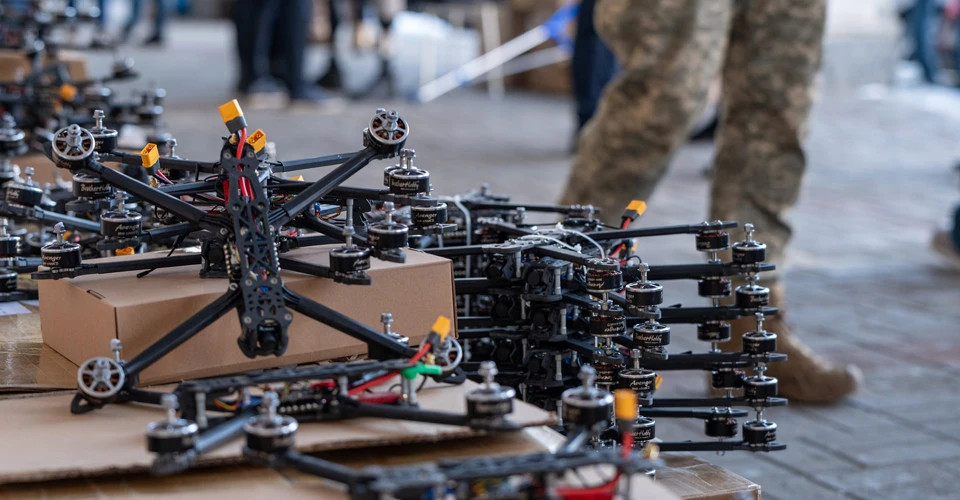
Importantly, artificial intelligence in this system is not an add‑on but a new logic for decision‑making. AI compresses the kill chain (“detect — decide — destroy”). Doctrine accordingly shifts from the classic network‑centric model with a single center to a federated network of autonomous decision‑making nodes based on AI. Distributed nodes — units, drones, assault teams — act autonomously within the commander’s overall intent, maintaining resilience under fire and EW effects and reducing the risk of a single point of failure.
The main conclusion for Europe follows: if Europeans truly want the continent’s security, they should abandon the inertia of the “ultra‑expensive elitism” of the peacetime defense industry and the detached “how can we help you?” posture. What is needed is not assistance but a joint defense system with Ukraine based on shared efforts, technologies, experience, and investments.
The drone wall will only be effective if built according to Ukrainian rules: technologies must follow the needs of the soldier and commander, priority must be rapid detection, accurate coordinate fixing and immediate engagement; autonomy and serial production — not one‑off “masterpieces” — must prevail. Europe’s joint military industrialization will be effective precisely with Ukraine, which is already a source of unique experience and knowledge. That is why Brussels’ decision on the €6 billion “Drone Alliance,” accelerated joint procurements of proven systems, and NATO’s “Eastern Sentinel” mission should be only the initial European reaction to the Russian threat. Next come systemic, joint steps with Ukraine, including a roadmap for a new European air‑defense architecture where proven Ukrainian solutions — cheap and effective, based on advanced technologies — prevail. It’s time to build this defensive wall together with Ukraine. Finally, European capitals are realizing that this is needed not primarily for Ukraine, but for Europe itself.
This material was prepared in cooperation with the Consortium of Defence Information (CDI), a project that unites Ukrainian analytical and research organizations and aims to strengthen information support and analytical capacity in national security, defense, and geopolitics.




- News