


Ceasefire along frontline: what it would mean for Ukraine



There is no shortage of war-end scenarios from experts of all kinds today. And a ceasefire along the frontline seems one of the more realistic options. But what could it look like? Would it resemble the “Korean model,” the dramatic for Ukraine “Minsk agreements”, or create a new formula for ending a 21st-century war?
Contents
1. Korean-style option: relevant but distant
2. Minsk agreements: guarantees at the cost of Ukraine’s future
3. Collective and national guarantees
4. Investment-attractive guarantees need a balanced approach
A ceasefire along the frontline is mostly associated with freezing the war along a Korean-style scenario. At the same time, many immediately warn that it could turn into new “Minsk agreements.” The fundamental difference between the two lies in the fact that the 1953 Korean peace agreement was much simpler in political construction than the Minsk agreements. Under the Korean model, the frontline simply stopped because it could not be changed by either side, with no political conditions other than a prisoner exchange. However, the military instruments of peace were much more extensive — a fully mined demilitarized zone, development of national armed forces, and special security arrangements: South Korea with the U.S., North Korea with China and the Soviet Union. Let’s take a closer look.
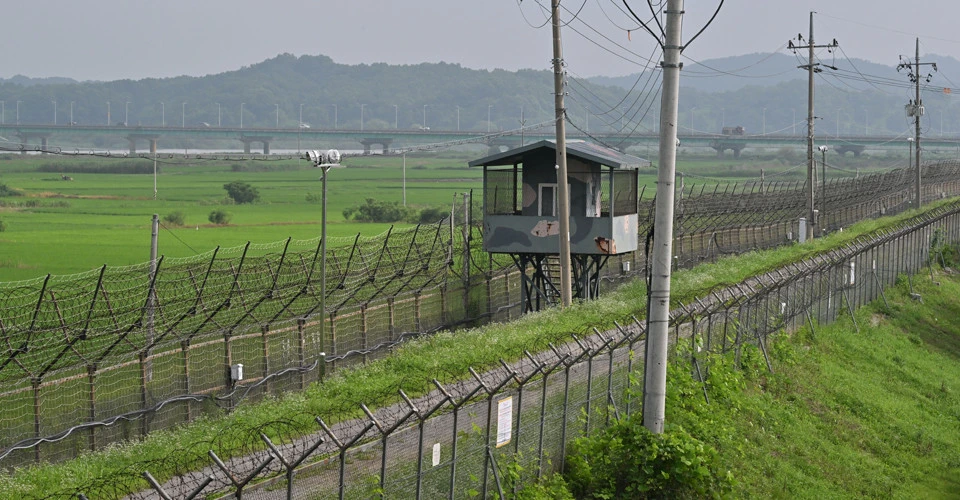
The wall on the border between South and North Korea, photo: Getty Images
Korean-style option: relevant but distant
The 1953 Korean Peninsula ceasefire was not a peace agreement in the classic sense. The armistice was signed not in Washington, Beijing, or Moscow, but in the Korean village of Panmunjom along the frontline by then relatively unknown generals: Nam Il of North Korea, Peng Dehuai of China, and U.S. General William Harrison on behalf of the UN and as a representative of South Korea. South Korea’s political leadership refused to sign, seeking total victory. However, it agreed to implement the armistice, gaining institutionalized relations with the U.S., which solidified the American military presence.
The armistice regulated only the ceasefire itself, its technical parameters, and nothing more. The most complex political issue, which delayed signing even when it became clear that the frontline could not be shifted in either direction, was the matter of prisoners of war. North Korea and China insisted on the “forced” return of all POWs to their countries of origin, regardless of their will. South Korea, the U.S., and their allies defended the principle of voluntary repatriation. A significant number of Chinese and North Korean POWs refused to return home, fearing reprisals (among the Chinese troops were Kuomintang supporters forcibly sent to fight on the communist side in Korea; naturally, they wanted to “return” to Taiwan). Even among South Korean, American, and allied POWs (including Britons), some did not want to return from the “communist paradise” emerging along the China-Korea border. The phenomenon of indoctrination of Americans and Europeans in Manchurian POW camps became legendary and was reflected in Western art.
Thus, Korean negotiations over POW repatriation lasted more than a year and constituted a significant part of the armistice discussions. Eventually, a Neutral Nations Repatriation Commission under the aegis of India was established to oversee and temporarily hold the prisoners. The exchange statistics were as follows:
In April 1953, during the so-called “small exchange,” the communists returned just under 700 UN forces troops, while UN forces handed over approximately 6,700 POWs to the communists. From August to December 1953, the “large exchange” took place. UN forces transferred 75,800 POWs to North Korea and China (70,200 North Koreans and 5,600 Chinese), in return receiving 12,800 POWs (7,900 South Koreans, 3,600 Americans, plus citizens of other allied countries). At the same time, 22,600 Chinese (14,700) and North Koreans (7,900) under UN control refused repatriation and were placed under the care of the Neutral Nations Repatriation Commission. Over 350 personnel from the UN side also chose not to return home. Separately, the South Korean government unilaterally released about 25,000 anti-communist North Korean POWs.
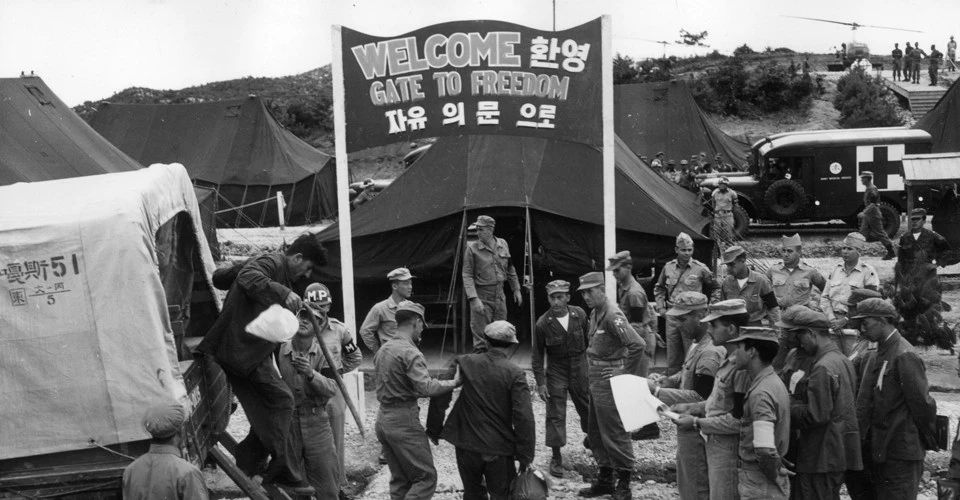
Prisoner exchange between the United Nations and the communists in Panmunjom, Korea, 1953, photo: Getty Images
The ceasefire established the front as a demilitarized zone averaging four kilometers wide and about 250 kilometers long. For decades this zone remained the most heavily fortified border in the world: tens of thousands of concrete structures, multi-layered obstacles, dense minefields. According to UN estimates, more than two million mines remain in and around the demilitarized zone — the largest mined area on the planet.
Mines long served as a key deterrent. They reduced the need to maintain large standing forces. But ultimately, only South Korea fully took advantage of this opportunity. Around the mines and fortifications, a multi-layered defense system formed: sensors, patrols, and mobile rapid-response units.
The balance of forces is the guarantee of the Korean peace. The U.S. supports South Korea with a 28,000-strong military contingent, modern air-defense systems, and airpower. North Korea relies on a mass army of over a million troops — a force whose maintenance seems incompatible with economic development — an embryonic nuclear capability, and Chinese economic support, and now even DPRK combat training in Russia's war against Ukraine.
This format of guarantees has its downsides. It effectively freezes the conflict for decades, with the risk of irreversible division of territories and their inhabitants into separate countries. Chaotic mining remains a problem for areas near the demilitarized zone. However, Korea has shown that even without a formal peace treaty it is possible to build a security architecture that enables peaceful prosperity if the right development path and allies are chosen.
One can say Ukraine is already drawing on the Korean experience — much of the defensive lines built in 2015–2016 still have not been breached by the Russians. A drone “kill zone” tens of kilometers wide has emerged along the front; Ukraine has begun the process of withdrawing from the Ottawa Convention on anti‑personnel mines, which will allow creation of a modern drone‑and‑mine demilitarized zone on the contact line with Russian forces. By building long‑range strike capabilities, Ukraine is laying the foundations to deter Russia from striking Ukrainian social and economic infrastructure after active hostilities end in the frontline “death zone.”
However, the key question is how far the Korean model can serve as the basis for long‑term guarantees for Ukraine. It creates a physical barrier that prevents large‑scale war but at the same time fixes territorial division. The Ukrainian variant of a demilitarized zone should be modern — modular and adaptive, relatively simple to deploy and relatively easy to wind down and relocate.
Minsk agreements: guarantees at the cost of Ukraine’s future
The Minsk agreements, signed in 2014 and 2015, formally appeared as a roadmap to peace. The list of points included a ceasefire, withdrawal of heavy weapons, prisoner exchanges, OSCE observer access, and the restoration of socio-economic ties. Minsk II even included specific deadlines: artillery withdrawal within two weeks, local elections by the end of the year. On paper, it looked like a system of guarantees: clear obligations with set deadlines.
However, the Minsk agreements required Ukraine to make internal political changes: amending the constitution, granting special status to Donbas, and holding elections under conditions agreed with Moscow and representatives of the so-called Donetsk People’s Republic and Luhansk People’s Republic. The military provisions of the Minsk agreements were strictly tied to Ukraine’s fulfillment of these internal political conditions. For example, Ukraine was to hold elections in occupied territories even before regaining control over the border. This logic created an incentive for Russia to delay security measures while demanding political changes in Ukraine. As a result, the agreements functioned as a trap: for Ukraine, implementing them literally meant legitimizing Russia’s influence over its politics without receiving real security guarantees. Russia, meanwhile, avoided direct obligations, positioning itself as a mediator. This allowed it to shift responsibility for implementation onto Ukraine while threatening escalation.
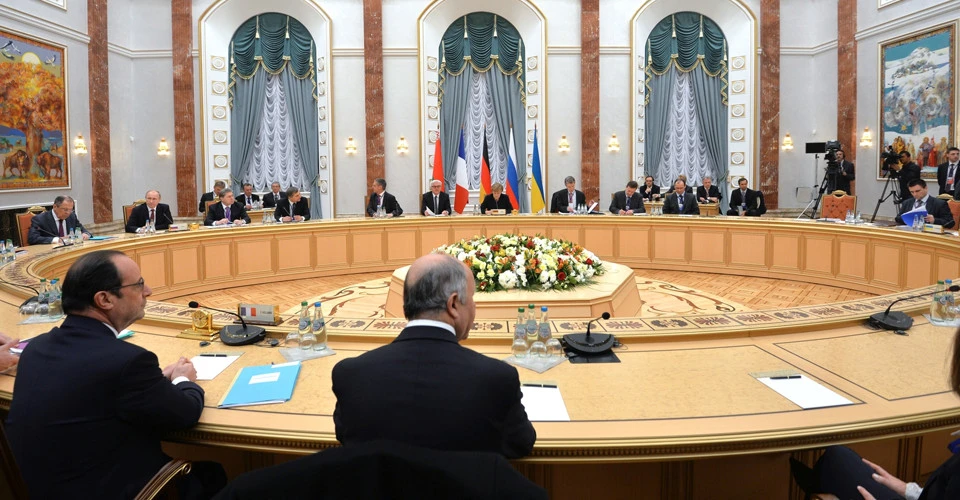
Normandy Format talks in Minsk, February 2015, photo: kremlin.ru
For Russia, the purpose of implementing the Minsk agreements was the same as what Russian speakers now mean by "demilitarization" and "denazification" — to deprive Ukraine of its defense forces, leaving only ceremonial units, and to strip political institutions of real power, leaving only symbolic ones. These were tools to establish a Russian protectorate over Ukraine. However, Russia failed to achieve this during the years of "implementation" of the Minsk agreements, which resembled a low-intensity war, as well as during the years of full-scale aggression.
Repeating the Minsk agreements is impossible, even if Russia renames them the "Istanbul agreements." Discussing them only makes sense to show how not to build a peace architecture: placing the burden of implementation on one side while leaving the other free to continue attacks and blackmail.
So how can a peace agreement under a "Korean scenario" be made without turning into a new Minsk-style agreement?
The key here, without a doubt, is security guarantees.
Collective and national guarantees
The collective response to external aggression, embedded in the structure of the North Atlantic Treaty Organization, an organization created to implement the North Atlantic Treaty, can pose an unacceptable risk for a potential aggressor. It is difficult to say who and when first called this a guarantee, but the risk of a collective response for decades restrained the Soviet Union and Russia from major aggression against Europe. A collective response works similarly to nuclear weapons: it creates a level of potential consequences that is too high for an aggressor to accept. For deterrence to work, both the collective response and nuclear weapons must be credible to the aggressor.
Including Ukraine in NATO’s extended nuclear deterrence system does not currently seem realistic. However, the likelihood of a collective response similar to that operating in NATO could be high for Ukraine.
In Eastern Europe, NATO guarantees through collective responses are realized at different levels of national military capability. In Poland, the main security guarantee is based on its own armed forces, strengthened by the capabilities of allies. In Romania, the guarantee is implemented through strong national capabilities combined with a much larger international component than in Poland. In the Baltic states, dependence on the international component is extremely high, especially in aviation.
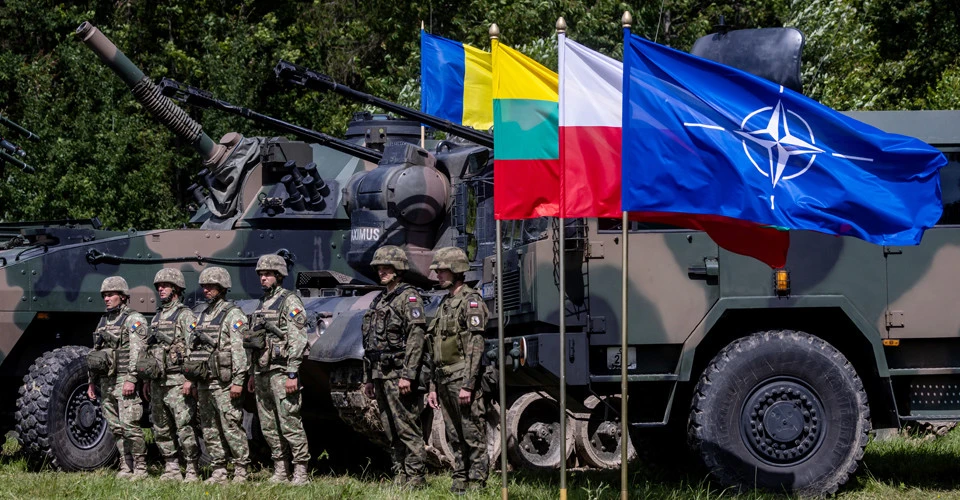
Polish and Romanian soldiers with military equipment and a NATO flag, photo: gettyimages
The share of national forces varies depending on the model: the larger the international component, the smaller the national one. Projecting this to Ukraine, considering its territory, population, and the level of threat for Eastern European countries, one could say that relying entirely on its own forces would require Ukraine to maintain a defense force of 800,000 troops; under the Polish and Romanian models, with reinforcement from international contingents on land, air, and sea, about 400,000 troops could suffice; under the Baltic model, with very high, even critical, reliance on international forces, 200,000 troops might be enough.
However, the likelihood of an adequate response to aggression decreases as dependence on international forces grows. Thus, the savings from relying on external guarantees come with risks. If national forces respond reliably, strengthening the response through international participation, as in the Polish model, may be slowed, and in cases of critical dependence on international reaction, as in the Baltic states, delays could be fatal.
Recent Russian air and naval provocations clearly demonstrated this problem. International monitoring of the skies, identification, air and ground defense response, and escorting of hostile targets work almost flawlessly. But only national air defense assets of the country whose airspace is violated can destroy them. Poland, with sufficient national air defense, can handle this. For the Baltic states, it would be problematic without additional international coordination, which takes time.
Considering this, the optimal guarantee model for Ukraine should be comprehensive. It should include a trigger for collective response (a military and logistical mechanism for rapid reinforcement), a strong national defense capability, and an engineered, protected front line or border with Russia.
It must also be noted that a reliable collective response to a broad spectrum of hybrid threats, including militarized ones, has not yet been fully developed globally. Within NATO, there is a consensus that hybrid aggression equivalent in impact to an armed attack can trigger collective defense measures. But Russia carefully ensures that its hybrid attacks remain below the threshold for a possible collective response from Europe and the United States. This explains recent drone attacks and airspace violations, designed so that the high threshold for military response, set to allow free air movement, lets Russia avoid consequences. The same applies to open seas.
This remains a problem. However, hybrid threats, if there is protection against military threats, are not yet critical and can be mitigated through political, social, economic, and informational measures.
Specifically, Eastern Europe and Ukraine are taking lessons from the Korean model of guarantees. By early 2025, Ukraine, Poland, the Baltic states, and Finland will no longer be constrained by the Ottawa Convention on anti-personnel mines in stopping Russian advances. At the same time, a European coalition, supported by the United States, is forming and ready to provide some form of guarantees to Ukraine if the war is halted along the frontline.
Investment-attractive guarantees need a balanced approach
For Ukraine, the question of guarantees is urgent. Not only because reliable security is impossible without external support, but also because it can be achieved through its own defense forces, provided they reach high quantitative and qualitative standards. This could even offer a higher level of military security than that provided to the Baltic states by international contingents.
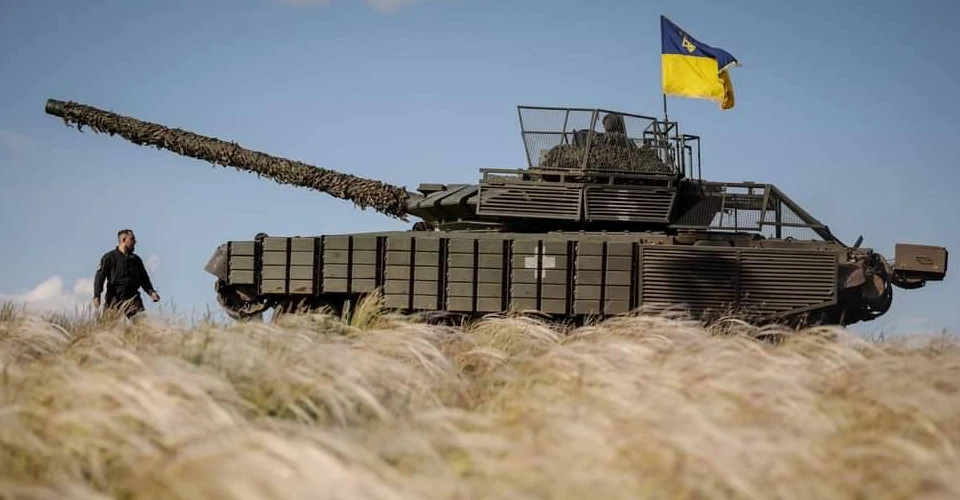
Ukrainian Armed Forces, photo: GeneralStaff.ua
At the same time, high quantitative and qualitative levels of defense forces require resources that may prove overly burdensome. North Korea, which catastrophically lags behind the Republic of Korea in human and economic development, has found itself in this situation largely due to a flawed balance between reliance on allies, national resources, and technology. Its own million-strong army drains resources, preventing technological development and the building of international alliances.
Thus, the question of long-term security guarantees is not limited to military instruments alone. Without reliable guarantees, investments in recovery and development are impossible. At the same time, excessive spending on defense forces and security apparatus will block investments. Therefore, the architecture of guarantees must be balanced between reliance on national forces, allied support, and new warfare technologies. In other words, while deterring Russian aggression, Ukraine must also remain attractive for friendly investments.
This material was prepared in collaboration with the Consortium for Defense Information, a project that unites Ukrainian analytical and research organizations and is aimed at strengthening informational support and analytical provision in the fields of national security, defense, and geopolitics.




- News