


American money, Ukrainian drones: Will Washington and Kyiv seal UAV deal?



Kyiv is in talks with Washington over investments in domestic drone production. Espreso TV breaks down the stakes, opportunities, and risks of this potential defense partnership
Contents:
- What’s known about the upcoming UAV deal — and why timing matters
- Which drones might go into production
- What the investment model and tech transfer could look like
- Risks, challenges, and the bigger strategic picture
What’s known about the upcoming UAV deal — and why timing matters

Last week, Ukraine’s Prime Minister Yuliia Svyrydenko announced that Kyiv and Washington are engaged in “detailed negotiations” on a bilateral agreement that could open the door to direct U.S. investment in Ukrainian drone manufacturing. The initiative envisions deep cooperation between the U.S. government, American defense contractors, and Ukrainian UAV producers.
“We’re planning to sign a ‘drone agreement’ with the United States,” Svyrydenko said. “We’re discussing investments in scaling up production of Ukrainian drones inside the U.S. That includes a large procurement deal for Ukrainian-made UAVs.” She added that the political decision has already been made by Presidents Volodymyr Zelenskyy and Donald Trump, and that technical discussions are underway.
The drone initiative is reportedly part of a broader U.S.-Ukraine Industrial Partnership, which aims to localize high-tech manufacturing in areas like defense, cybersecurity, and critical materials. According to Ukrainian government sources, the UAV component could be among the first operational projects — with potential implementation by the end of 2025. Beyond financial support, the deal may include tech transfers, joint assembly, and operator training.
The timing is critical. Ukraine is rapidly transitioning from a procurement-based model to domestic production. While FPV drones have become a hallmark of asymmetric battlefield effectiveness, Ukraine remains highly dependent on foreign imports for key components like long-range strike drones, precision parts, and drone defense systems.
But this isn’t just about Ukraine’s needs. For Washington, the proposed collaboration is a strategic investment. In today’s evolving geopolitical climate, the U.S. seeks to strengthen NATO’s defense architecture by expanding industrial partnerships. With Ukraine fighting an active war, the country has become a real-time testing ground for next-gen military technologies. It’s no coincidence that the Pentagon recently announced a new UAV pilot training program — a "Top Gun for drones" — explicitly shaped by Ukrainian battlefield experience.
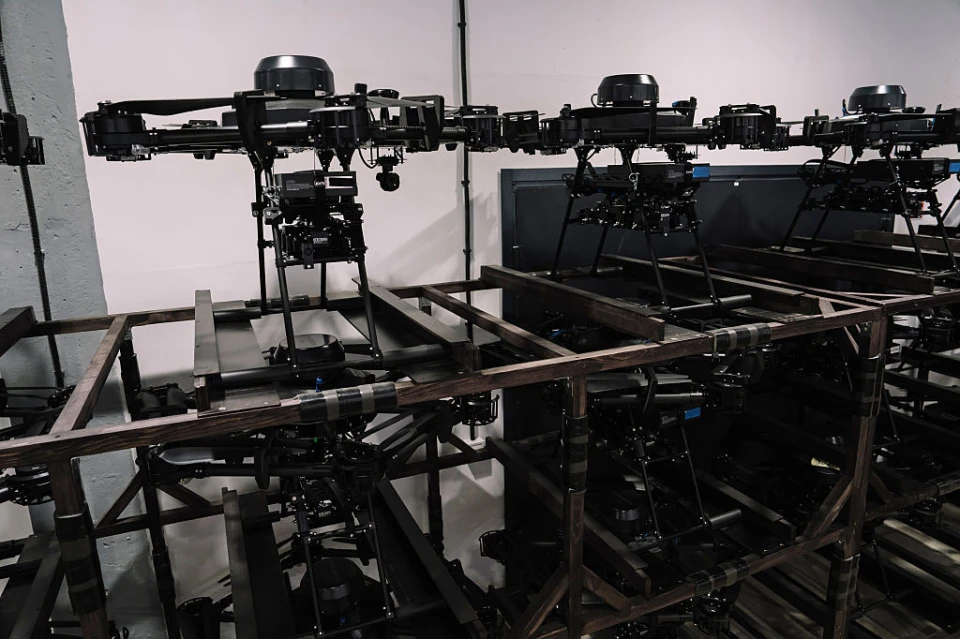
As Brandon Tseng, co-founder of U.S.-based drone maker Shield AI, told Defense One, “If you are not operating in Ukraine, then your stuff is not serious.” In August, U.S. troops will gather in Indiana for the inaugural “Top Gun” drone course — focused on kamikaze UAV tactics drawn from Ukraine’s frontline know-how.
Which drones might go into production
So far, neither side has disclosed the names of the companies involved. But based on publicly available information, likely American candidates include:
- Skydio – known for AI-enhanced reconnaissance drones
- Anduril Industries – pioneers in combat UAVs using advanced automation
- General Atomics – makers of the MQ-9 Reaper, long sought after by Ukraine
From the Ukrainian side, participants may include well-established drone manufacturers such as Ukrspecsystems, Skyeton, DeViRo, and A.Drones, as well as less-known but fast-scaling startups with battlefield-tested products.
What could joint production entail? Likely candidates include:
- Medium-range strike drones (similar to Turkey’s Bayraktar TB2, but with U.S.-made optics and munitions)
- AI-powered recon UAVs capable of operating in GPS-denied environments
- Drone swarms made up of dozens of coordinated FPVs
- Next-gen kamikaze drones guided by infrared and acoustic sensors
What would the investment model and tech transfer look like?
Experts interviewed by Espreso TV suggest a joint public-private investment model as the most viable path forward. This would allow the U.S. to ensure compliance with security standards, tech safeguards, and scalability — while enabling Ukraine to gain access to critical components such as optics, engines, and secure communications, which are nearly impossible to import directly today.
Of course, intellectual property and licensing will be among the thorniest parts of the deal. However, past U.S. collaborations with Israel and South Korea show that meaningful tech transfer is possible when transparent export control frameworks are in place.
Whether Ukraine, amid wartime constraints and persistent governance issues, can meet these requirements remains an open question. But it’s not a deal-breaker — mechanisms can be found.
Risks, challenges, and the bigger strategic picture
The risks are real. First and foremost: security. Any domestic drone manufacturing hub will need hardened, possibly underground or widely dispersed facilities to withstand missile threats. Bureaucratic inertia is another hurdle — both U.S. and Ukrainian defense regulations are notoriously complex and slow-moving.
There’s also a talent bottleneck: Ukraine lacks enough certified engineers, drone operators, and production technologists to scale quickly.
Still, the effort may be well worth the political and strategic payoff. If successful, this drone deal would mark the most significant vote of confidence in Ukraine’s defense sector from Washington since 2022. It would reposition Ukraine not merely as a recipient of military aid but as a capable developer and manufacturer.
It would also signal continuity of U.S. defense cooperation with Ukraine regardless of political changes in Washington — underlining the fact that the U.S. defense industry often operates with strategic autonomy across administrations.
Moreover, establishing UAV production on Ukrainian soil would contribute to a long-term NATO deterrence strategy against Russia. The Pentagon’s recent decision to integrate Ukrainian know-how into its UAV doctrine and training programs is already a milestone in this direction — and a powerful endorsement of Ukraine’s battlefield ingenuity.
If the deal is fully realized, it could elevate “Ukrainian Defense Tech” as a global benchmark for adaptability, innovation, and war-tested effectiveness.
This article was produced in partnership with the Consortium for Defense Information (CDI), a project uniting Ukrainian think tanks and research institutions to enhance national security and geopolitical analysis.




- News